


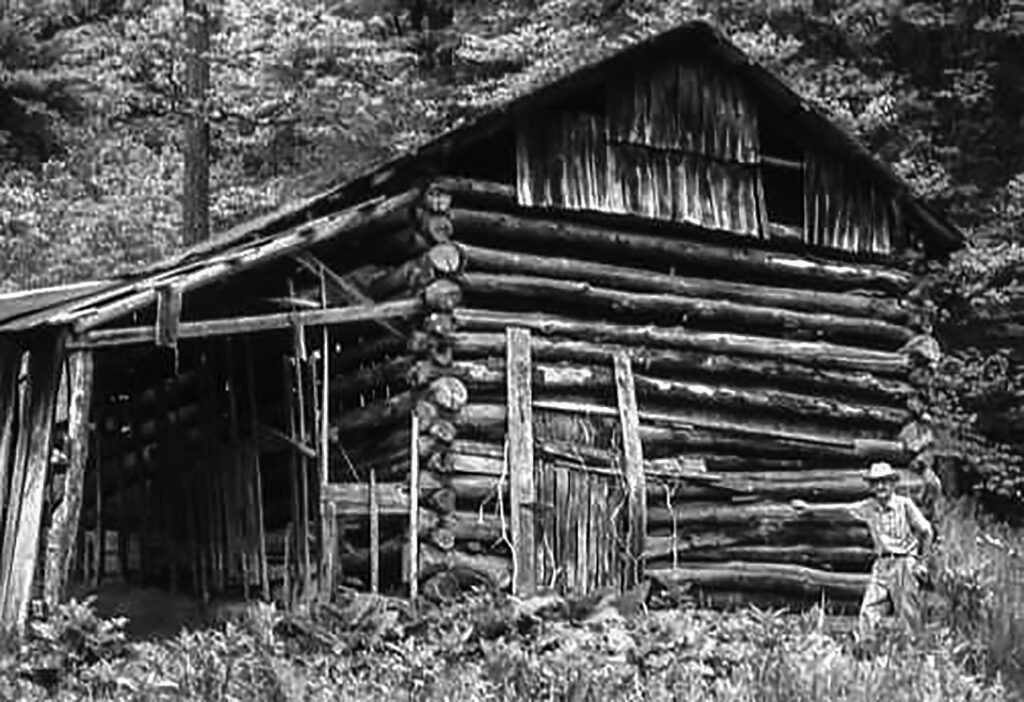
Text and Photos by Gerald Milnes
No object, be it animal, vegetable, or mineral, brings about a more loathsome state of mind to many people than the lowly snake. It seems everyone has an opinion about them. A few who are attuned to and accepting of the natural world are neutral or better, but most are not. Throughout history the Judeo-Christian mindset, with its negative association of snakes with evil, has solidified this thinking. It begins with the Book of Genesis, Chapter 3. Here, the creature tempted Eve into trying the forbidden fruit from the Tree of Knowledge of Good and Evil.
This caused the downfall of mankind according to Scripture, and thus put God’s burden of childbirth onto women among other adverse aspects on all of mankind. God further cursed the serpent to forever crawl on its belly for tempting Eve. Through history, in the hills of West Virginia, where actual danger exists from two distinct local species—rattlesnakes and copperheads—the detestation of all varieties of snakes gained even more prominence. Sadly, even though any actual danger from snakes is minute compared to such things as driving in traffic, a commonly found expression is, “The only good snake is a dead snake.”
This mindset does not entirely engulf the state’s population. Much notice is given to common black snakes. Many farmers, for instance, appreciate the blacksnake for its vermin eliminating traits, and welcome their presence in barns and granaries. Many other species go about their daily lives feeding on unwanted insects as well as the ever-present mice that are a common pest of country living.
Perhaps in a more magical vein, a Pendleton County farmer told me of another use for blacksnakes. He said when a neighbor’s farm was overrun with rats, a blacksnake was killed and was drug around the house three times. Then, the snake was laid down and pointed in the direction they wished the rats to leave. This, he said, caused consternation in the neighborhood because the rats then overran another farm in the direction they were appointed to go. The magical number, three, is important here and may be found in many such charms and invocations from ancient magical thought.


“The weather cure was to kill a blacksnake and hang it over a fence, belly up. This was believed to bring rain within three days.”
Pictured: Anthony Swiger, of Randolph County.
Another common, although unscientific, use of blacksnakes, told to me by several older residents, was a cure for drought when rain became critical for crops. The weather cure was to kill a blacksnake and hang it over a fence, belly up. This was believed to bring rain within three days. One older Randolph County fellow, Anthony Swiger, told me he did this one time and it rained soon after. Offering a qualifier, he said that it may not work every time, but it did in that instance when he tried it.
Herpetologists, those who study reptiles, will tell you that snakes are not inclined to protect their young—a trait found in birds and most other higher forms of animal life. However, several old timers have related to me that they witnessed that very event. They tell of very young snakes, more than a dozen and the size of fishworms, wriggling into their mother’s mouth for safety when sensing danger as the person happened on the scene. One Braxton County man said, “I know that to be a truth, because I witnessed it with my own eyes from a distance of twelve or fifteen feet.” Now, from a scientific point of view, no baby snake could endure the gastric juices of a snake’s digestive system and come out alive, but I will not call this man, or others, untruthful. I know, when it comes to the folklore surrounding snakes, people will believe what they want to believe, and I am not inclined to question their convictions. If fact, I find some satisfaction in that ancient thought processes still linger on with folks in the digital age. While science may not support such beliefs that Jonah survived in the belly of a whale, or the weather-predicting abilities of woolly worms, or even the existence of Bigfoot, people are rightfully in sole control of their own beliefs.
Pliny the Elder, the Roman philosopher and naturalist who wrote treatises on natural history over two thousand years ago, said of the ash tree, “So great are the virtues of this tree that no serpent will lay in the shadow thrown by it.” This ancient belief still exists today. Gilmer County’s Phyllis Marks, no stranger to many folk traditions, said she kept an ash tree planted in her yard to keep the poisonous snakes away. She also said that when her mother and aunt with babies went out to hoe the corn fields, they would lay the babies on quilts and encircle them with ash bark to keep the snakes away while they worked down the corn rows. A farmer in Braxton County, Otis Rose, told me that one time he and others had caught a rattlesnake, and that they enclosed it in a small pen by putting ash limbs around it. He said that the snake would not cross the ash branches, and it stayed right there until it died. Where else could the knowledge of this ash repellent belief have originated, if not for Pliny the Elder’s two-thousand-year-old writings?
“He said the older folks present said he had to take the entrails of a black chicken and put that on the wound of the bitten arm, and it would “draw the poison out.””
Pictured: Otis Rose of Braxton County.


Otis Rose, and several others, told me of a curious cure for snakebite. This would be a bite of one of the poisonous pit vipers, a copperhead (often called a “coppersnake”) or rattlesnake, that can cause serious physical distress. He said that one time his brother was raking up hay and a copperhead he had raked up bit him on the arm. He said the older folks present said he had to take the entrails of a black chicken and put that on the wound of the bitten arm, and it would “draw the poison out.” He said his brother was sick, but survived. Many kinds of poultices are placed on wounds, etc., to affect a cure, but stating that the chicken must be the color black suggests a more mysterious derivation. I had heard this same black chicken cure from others. One was another Braxton Countian who suggested that after the cure took effect, every year after that a resemblance of the wound would reappear on the day he was bitten. This annual recurrence of a snakebite wound is a widely held belief.
Calhoun County’s Phoeba Parsons, a person of much traditional folklore and belief besides her music and dance talents, was herself a victim of rattlesnake bites as a child. She described the precautions taken in her case. She said a bottle of turpentine was turned up on the snakebite to draw out the poison and she was not allowed to eat anything but a little bread and milk. The belief was that her diet would greatly affect her reaction to the bite. There was further worry because she was bitten during Dog Days, a period when snake bites are thought to be most dangerous. She said her parents used “rattlesnakes masterfield,” which may be the plant called rattlesnake master (Eryngium yuccifolium), whose roots were traditionally used as a cure for snakebite. This was mixed with cornmeal for a poultice. Her bite caused her leg to swell up considerably, but it soon dissipated. Another bite she endured was on her forefinger of her right hand, which caused the end to slough away, exposing the bone on that short digit for the rest of her life.
Others who were bitten, although rare, were not so lucky. My favorite old-time storyteller, Kent Lilly of Mercer County, described an uncle who was bitten by a rattlesnake. Kent said his uncle went by the nickname “Wid” Lilly. Upon being bitten and without access to medical attention, family members decided to place him in a hole in the earth with only his head protruding. The thinking was that the coolness of the earth would suppress the throngs of fever and pain he was enduring. He was also given a strong dose of moonshine to counteract the poison, which Kent thought was a big mistake. Despite all attempts by the family to alleviate the uncle’s distress, he succumbed to the poisonous bite and died. Kent finished his descriptive tale of the event by noting the epitaph on his uncle’s tombstone. He said it reads: “Here lies the bones of Wid, the snakebite didn’t kill him, but the cure did.”


“The snake had him “wrapped,” and he “couldn’t get his breath.” He was barely cognizant enough to cut off the snake with his penknife, as it coiled around his body.”
Pictured, Phoeba Parsons of Calhoun County.
Phoeba Parsons, noted above, was one of many folks who believe that snakes can “charm” people. She told of a one hundred-plus year-old man who was a friend of her family. He had regularly fed a snake that crawled out of a hole in his hearth. However, one evening the man awoke from a stupor, according to Phoeba, having been charmed. The snake had him “wrapped,” and he “couldn’t get his breath.” He was barely cognizant enough to cut off the snake with his penknife, as it coiled around his body. Phoeba told of another man who claimed he wasn’t afraid of snakes charming anyone, but soon after was coming along a wooded path and noticed a snake was following him. As he stared at the snake, she said, he found himself “falling in on it,” at which point he regained consciousness and killed the snake. The widely held belief contends that snakes have the power to “charm” or lure people into a semi-conscious state, to harm them in a sinister way. This belief is bolstered by many accounts of people, like Clyde Case of Braxton County, who claim to have witnessed snakes able to charm birds, ground squirrels, or other prey items. It may be true that these prey creatures freeze out of fear, and perhaps this same thought process gets applied to people.
Phoeba also said, “The racer snake will run you.” She told me a tale of her mother being almost charmed by a black racer that chased her down a hill when she was out bringing the cows home for milking. She noted that the snake was “standing up.” This does not mean the black racer was totally erect, but black racers can raise their head and first quarter of the body while moving at a considerable speed. Phoeba noted that her mother barely sidestepped the snake which went over the hill, but that it almost had her “charmed.”
“This belief is bolstered by many accounts of people, like Clyde Case of Braxton County, who claim to have witnessed snakes able to charm birds, ground squirrels, or other prey items.”
Pictured: Clyde and Lucy Case of Braxton County.


A Gilmer County man, Graydon Richards, told me of an old farmer who was picking berries when he was charmed by a black snake. He said the snake had “wrapped him,” which kept him from getting his knife from his pocket as he was barely conscious. His brother saw his dilemma and cut the snake into pieces. Graydon was a wood carver and he carved canes with black snakes curling up their shafts, a common motif. Folk art is an expression of values, and the respect for the danger associated with snakes is visually expressed in this art form. Snakes have a long association with canes and walking sticks, are often depicted crawling up the shafts, and the tradition may relate to the Biblical account of Moses, whose staff magically turned into a snake.
From my own experience, the hognose snake, commonly known as a puff adder, or in West Virginia a “blowin’ viper,” although quite rare these days, exhibits the most bizarre behavior of any snake in our mountains. Several people had told me about this curious critter, the most common belief being that it can blow poison at you, but it can’t bite you because “God locked its jaws.” This was invoked to me by several old-timers, but it is unclear to which Biblical verse they are referring. Sylvia Cottrell O’Brien of Clay County, stated that the blowin’ viper can blow poison at you and it can infect you if it contacts a sore place, but it can’t bite you because “God locked its jaws.” William May of Mingo County said he’d heard the Bible story since he was a kid that God locked its jaws. Old Israel Welsh, of Mineral County, said the blowin’ viper will flatten its head and huff and puff “like a country preacher.” Then, if it doesn’t scare you off, it will roll over on its back, play dead, and a “red-looking syrup” runs out of its mouth. As peculiar as this sounds, one time while building fence in a wooded area, I heard a strange puffing sound and spotted a blowin’ viper about four feet away with its head spread out like a cobra, and it was huffing and blowing in my direction. After observing this for a minute or so, the snake stopped, rolled over on its back, and its reddish wet tongue protruded from the side of its mouth, exactly as Israel described. The so-called “poison” that it blows, is in fact not poisonous at all, but the belief is widespread. According to authorities, this harmless snake is rarely encountered and may be in danger of extinction.


“Old Israel Welsh, of Mineral County, said the blowin’ viper will flatten its head and huff and puff “like a country preacher.” Then, if it doesn’t scare you off, it will roll over on its back, play dead, and a “red-looking syrup” runs out of its mouth.”
Pictured: Israel Welsh of Mineral County.
Israel Welsh also gave me a story about the milk snake, the name of a colorful snake sometimes confused with a copperhead. The official descriptions of the snake do not suggest the folk belief that snakes can suck milk from a cow as the name implies, but that may be the origin of the name. In Israel’s account, one time they noticed the milk production of one of their cows was going down significantly. Upon inspection, they found a black snake was sucking her milk. He said they killed the snake, but the cow went around bellowing for two or three days like a cow does upon weaning a calf.
Another unusual snake, completely foreign but mentioned to me, was the “glass snake.” This critter is thought to have the ability to break apart when in danger and put itself back together when the danger subsides. Although mentioned as a distinct type, no one has ever told me they witnessed this event. The “hoop snake” is commonly thought to be able to grasp its own tail and roll downhill. It is believed to chase people and have a “stinger” at the end of its tail. People say to always run uphill to get away, as it can only roll downhill. If the snake strikes a tree with this “stinger,” the tree will die. This tale may be the most widely known among the extreme powers attributed to snakes. Some folks are dubious, but others accept the reports who have heard of first-hand accounts from “witnesses.”
I have collected four accounts of a historic tale known as “The little girl and the snake” in Randolph, Marion, Gilmer, and Clay Counties. The tale was first collected by the Brothers Grimm, in Germany, in the early nineteenth century. The West Virginia versions, though geographically separated, are surprisingly similar in details. In this tale, a little girl, unknown to her parents, befriends a snake. Every day she feeds the snake milk and bread. Phyllis Marks said, “The snake had the child charmed.” This feeding always takes place at a small springhouse or outbuilding on a farm. The implications are that this portends a symbiotic relationship between the girl and the snake. “The little girl takes a bite, then the snake takes a bite,” is heard within the tale. In time, her parents become aware of her actions and upon following her one day, they discover the situation. In some versions it is a copperhead and in others it is a rattlesnake, both presenting danger to the child. Upon discovering the circumstances, the parents kill the snake, and the child soon dies. This ancient tale seems inspirational to “The Little Girl and the Dreadful Snake,” a bluegrass song written and made popular by Bill Monroe.
“She also said that when her mother and aunt with babies went out to hoe the corn fields, they would lay the babies on quilts and encircle them with ash bark to keep the snakes away while they worked down the corn rows.”
Pictured: Phyllis Marks of Gilmer County.


Sometimes country fiddles are found to have snake rattles inside. Some think it is to keep mice away as fiddles with enlarged F holes are seen where mice have chewed their way inside. Some think the rattles keep cobwebs from forming inside. Others say it helps the sound or brings good luck in a magical way. African American blues men traditionally also put rattles in their guitars as well as in fiddles. Further, in West Africa, when a new musical instrument is made, objects are put inside to give it its power. I believe this to be the origin of the rattles in fiddles tradition. The symbolic Revolutionary War flag of the Continental Army, “DON’T TREAD ON ME,” created in part by Benjamin Franklin, is an early example of the rattlesnake used as a symbol of power. The snake is respected in this sense and in fiddles the rattles add to an immense amount of folklore associated with the instrument.
There are sixty-three mostly negative Biblical references to serpents and snakes, many associating the creature with evil, which may in part be the ancient root cause of the adverse connotations associated with snakes. There is real and present danger with our two poisonous pit vipers that have added to the negativity. From ancient mythological examples, to Biblical references, to modern detrimental thinking, the lowly snake is feared, written about, represented artistically, and generally cast in a negative role through the many beliefs and tales about their magical powers and capabilities. Despite scientific evidence, the many supernatural beliefs are likely to continue.


GERALD MILNES
"Snakelore." Goldenseal West Virginia Traditional Life, Fall 2025. https://goldenseal.wvculture.org/snakelore/