

Written by Dennis W. Bills II
On a stretch of road along the Guyandotte river about 5 miles from the town of Logan, is a vacant 400-foot strip of land. Along that strip runs West Virginia State Route 10. The strip is not very wide, from the road, maybe thirty steps till the bank drops into the river. The bank is scattered with trees and shrubbery and litter from the ebb and flow of the river. To stand on this piece of near useless land today one would never guess that a business once existed there. But, for nearly thirty years one did, one that supported a family of six with an attached four room add-on. It wasn’t a service station, not even a grocery store—it was a “produce market.”
The Early Years
Dennis Bills was born on Fall Creek in Lincoln County in 1912. Today the State has a sign on Route 10 pointing to Falls Branch. Dennis was one of 9 children born to Viola (Hubbard) and Walden Bills who owned a farm on the creek. Early in the depression Walden lost the farm to debt and in 1932 died, leaving the family to fend for itself. It is said Walden sold produce at the mouth of Fall Creek on Route 10, and had a fear of leaving the Creek lest he die. Walden was 37 years old when he married Viola at the age of 13, a common age gap in those days. She had her first child at age 14 in 1908.
When the family lost the farm, by the grace of a neighbor, they were given a shack to live in on adjoining property. “You could see daylight between the boards,” one of the brothers, Golden, described the house. Dennis was still living in Lincoln County (near West Hamlin) when he was drafted into the Army in 1943, and spent two years active duty in the South Pacific. In Lincoln County, at that time, education was not a high priority. Consequently, Dennis only went to the 2nd grade. His brother Roy joked that he himself went to school for a day, and that was in his brother’s place.
“Year after year until the Justice Dam was built, the produce market took direct hits from the Guyandotte nearly every spring. It was sometimes so devastating the family would be homeless for a while, living with friends, or wherever they could afford, until they could clean the river mud out and start over again.”

The Start
After discharge from the military Dennis joined his brothers Woodrow (Carbo) and Roy in peddling produce, following in their father’s footsteps. They eventually ended up in Logan County in the town of Logan, running their meager business out of the back of a pick up truck. Later, they acquired a store in a part of town called Deskins or Ellis Addition, known at the time as Black Bottom. Although little is known of the business, it is evident they survived because in 1946 Dennis met Anna Louise Staten who was working behind a soda fountain in a drug store in downtown Logan. His frequent visits eventually resulted in a marriage in July of 1947.
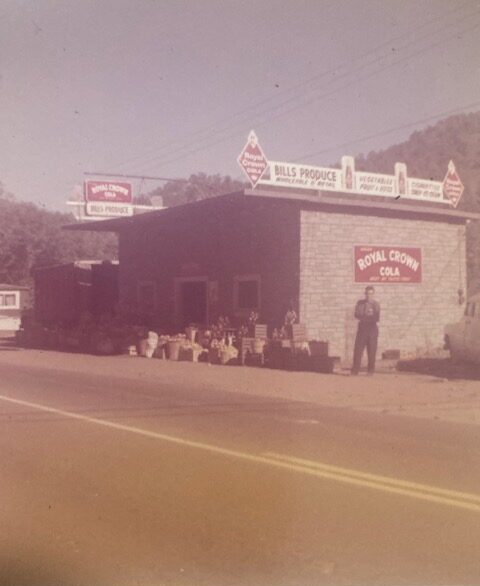
Sometime before they married, in that same year, brother Carbo was killed in a car crash driving in what was described as a sports car on Route 10 in Lincoln County. Although it was catastrophic, Dennis and Roy continued running the produce market, mainly because they knew no other means to make a living. A large Royal Crown Cola sign was hung at the front of the market welcoming customers to Bills Produce. Anna, who had an 8th grade education, was brought in to help with the business. Roy eventually moved on to other things.
Times were not great for Dennis and Anna as they struggled to keep the business afloat. They lived in the back of the store and eventually moved to an apartment over the market. Nearly every year in Black Bottom the Guyandotte backwater would flood the store and the couple would have to start over. This seasonal flooding went on until 1954 when a house caught fire in a section of Black Bottom known as Shanty Town. House after house burst into flames and the fire eventually made its way to the produce market.

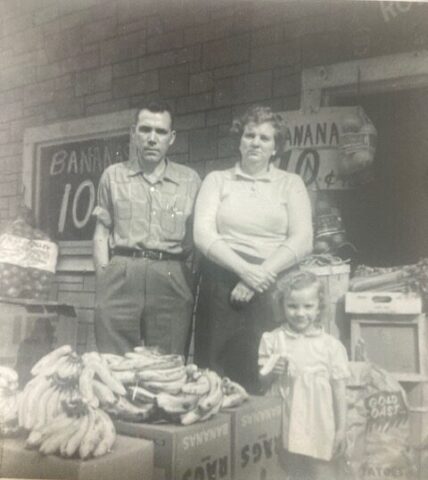
“Not long after the fire, Dennis rented another building a little closer to Logan but still in Deskins/Ellis Addition. Another sign was hung and Bills Produce continued in business for the next six years, floods and all, with family living above.”
With little time to react, Dennis and Anna, now with three children, escaped with literally the shirts on their backs. Coming back the next day with the three kids in tow, there was nothing left but smoldering ashes [I remember like it was yesterday when I was sitting in a car across from the ashes of the building and we two boys suddenly remembered that our two rabbits didn’t make it out. It was the first catastrophic thing to happen in my life. It was one of several times that my family was without a home to live in.]. As a result of losing everything, the family for a time moved in with Anna’s mother, Ella Campbell Harris and her husband Clarence, until Dennis could “get back on his feet.”
Bills Produce Continues
Not long after the fire, Dennis rented another building a little closer to Logan but still in Deskins/Ellis Addition. Another sign was hung and Bills Produce continued in business for the next six years, floods and all, with family living above. In 1960, Dennis borrowed enough money to buy a piece of property on Route 10 along the Guyandotte river. Just across the river was the community of Henlawson, but the US Post Office gave the new store with the “Bills Produce” sign the address of Justice Avenue just a couple of miles from the thriving community of Justice Addition.
“As the kids grew older and each left home, Dennis and Anna started to slow down but kept the store open.”

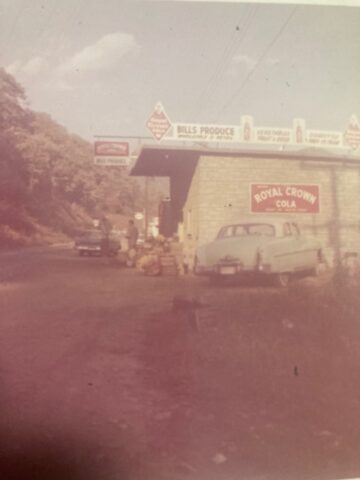
A year later Dennis and Anna built a “shotgun” two bedroom addition attached to the store and moved, now with three boys and a girl. All the children slept in one bedroom. Anna and Dennis took the other bedroom. There was a kitchen with running water, a living room, and a small empty room with no facilities, called the bathroom. At night the family would use a chamber pot [For baths Mom would put the kids in a big wash tub in the kitchen where we had running water. The family went without a bathroom from the time I was in the sixth grade through the 9th grade]. There was an outdoor toilet over the hill beside the store until the river washed it away and left the family homeless again in the spring of 1963.
All Now Gone
The produce business was never a really successful endeavor for Dennis and Anna and they always seemed to struggle, barely making ends meet. In the winter, Dennis would turn to poker to help support (when he would win) the family. Once, he was gone all night and when he came home all he had were two rubber bands in his front pocket where he usually kept his money [It was the first time I ever saw him cry].
Year after year until the Justice Dam, later named the R.D. Bailey Dam, was built, the produce market took direct hits from the Guyandotte nearly every spring [Work on the dam began in in 1974, construction began in 1967 but wasn’t completed until 1980, Castle Comments – US Army Corp of Engineers website]. It was sometimes so devastating the family would be homeless for a while, living with friends, or wherever they could afford, until they could clean the river mud out and start over again. In those days there was no such thing as flood insurance. But determined, and mainly for the lack of any other way to make a living for this family of six, Dennis would find enough money to come back and start over again.
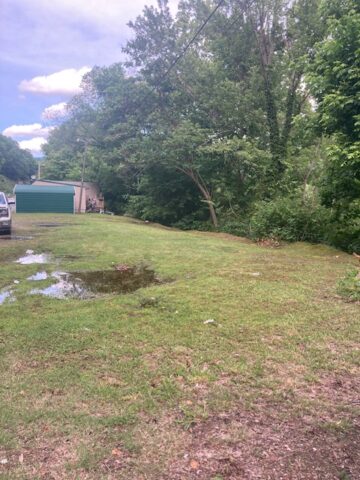
“Today, one can drive by that now empty spot on Route 10 on the Guyandotte and never know that there once stood a struggling business where a small family of four children were raised that moved on to live productive and successful lives.”
As the kids grew older and each left home, Dennis and Anna started to slow down but kept the store open [In 1966 I graduated from Logan High School and attended the Marshall Logan Branch college the first year. The second year on college loan money I left for Huntington, WV and Marshall University happy to be out from under the burden of the “Produce Market” where I had worked from an early age. I was never to return permanently, only to visit]. In 1980 Anna had a heart attack at the age of 60 and a few weeks later she died. Dennis’ loss was great but he still kept the store open for a couple of years. He was never a man of religion but somewhere he “found the Lord” after Anna’s death.
A few years later he developed colon cancer. After one operation and several unsuccessful treatments in which his daughter Kathi cared for him in Logan, he succumbed to cancer and died in 1987[Before the cancer took over completely he came to stay with me and my wife Jan in Huntington to give Sister Kathi a “break”. From our conversations I could tell he missed the days of “running” Bills Produce so one day I took him to the wholesale produce market in Huntington and we bought boxes of fruits he could put in bags. I gave him my pickup truck and he would go sit on the side of the road on Route 60 and sell his bags of fruit. I think he knew that time was short, but we pretended nothing was wrong and could never talk about it, even to his last day].
The store and house stood empty for a few years but, eventually, the land was sold to help pay the medical bills. Today, one can drive by that now empty spot on Route 10 on the Guyandotte and never know that there once stood a struggling business where a small family of four children were raised that moved on to live productive and successful lives.


Dennis W. Bills II
"Bills Produce." Goldenseal West Virginia Traditional Life, Winter 2025. https://goldenseal.wvculture.org/bills-produce/