

By Ella Dunigan
Pretend you are walking through the forest in West Virginia and all of the sudden you find a hidden entrance leading down into the earth. That’s right, West Virginia has a secret world beneath it—caves that are full of history, mystery, and some of the craziest rock formations you’ve ever seen. Let’s look “deeper” at the subject of the caverns found in West Virginia.
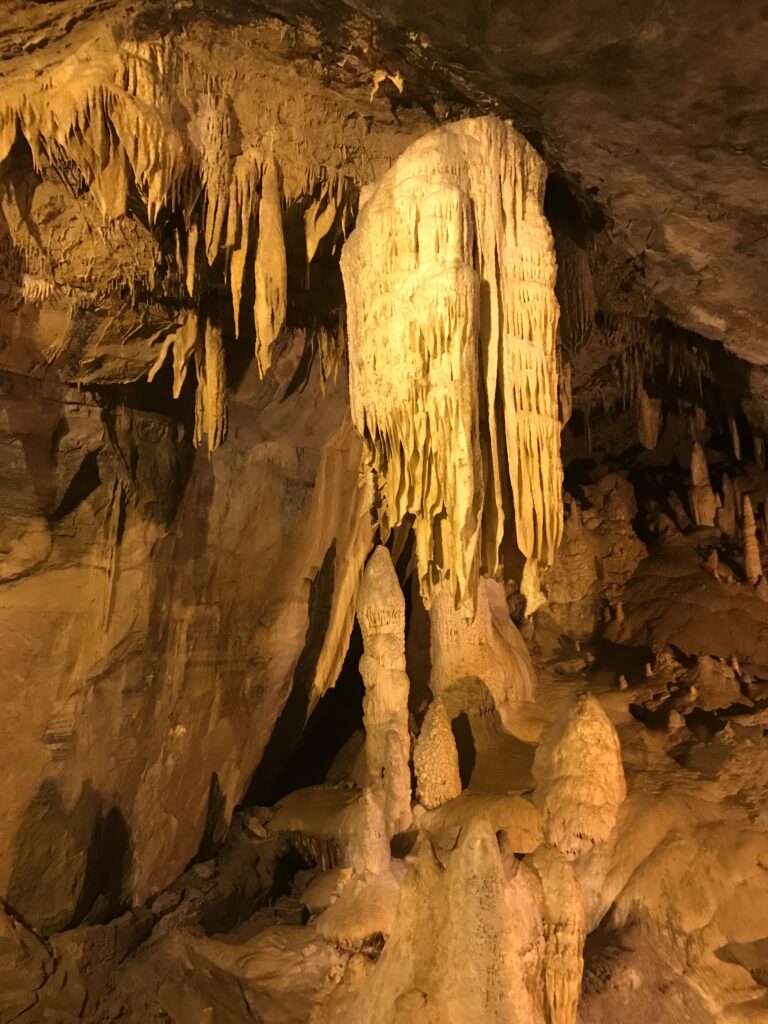
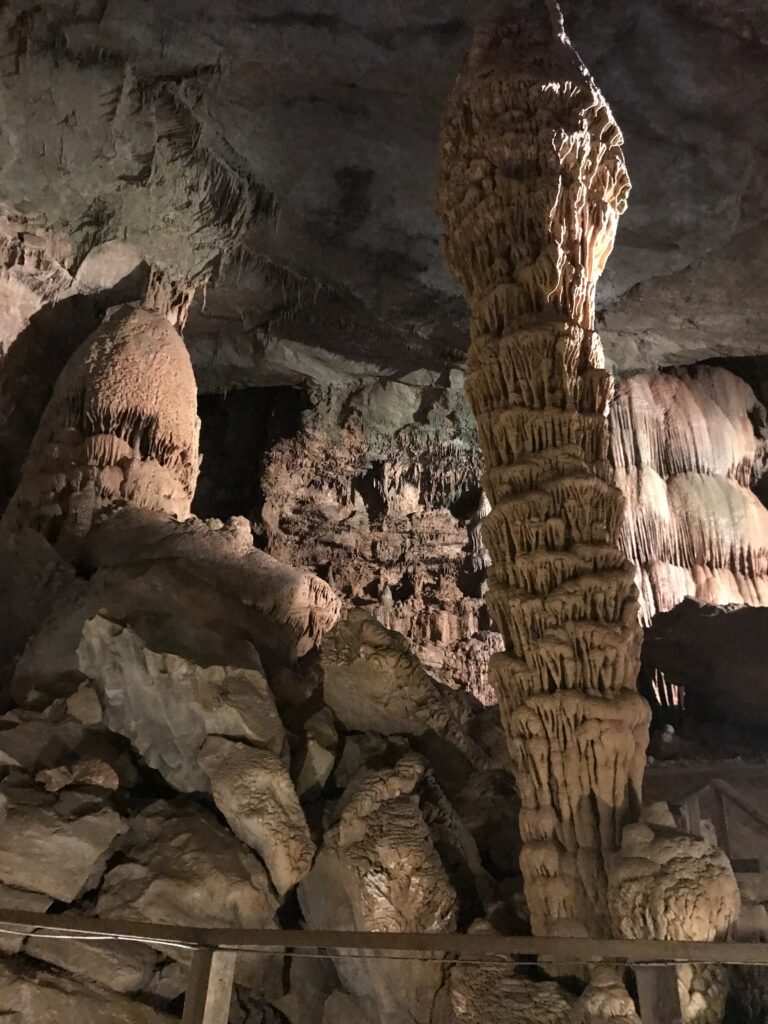
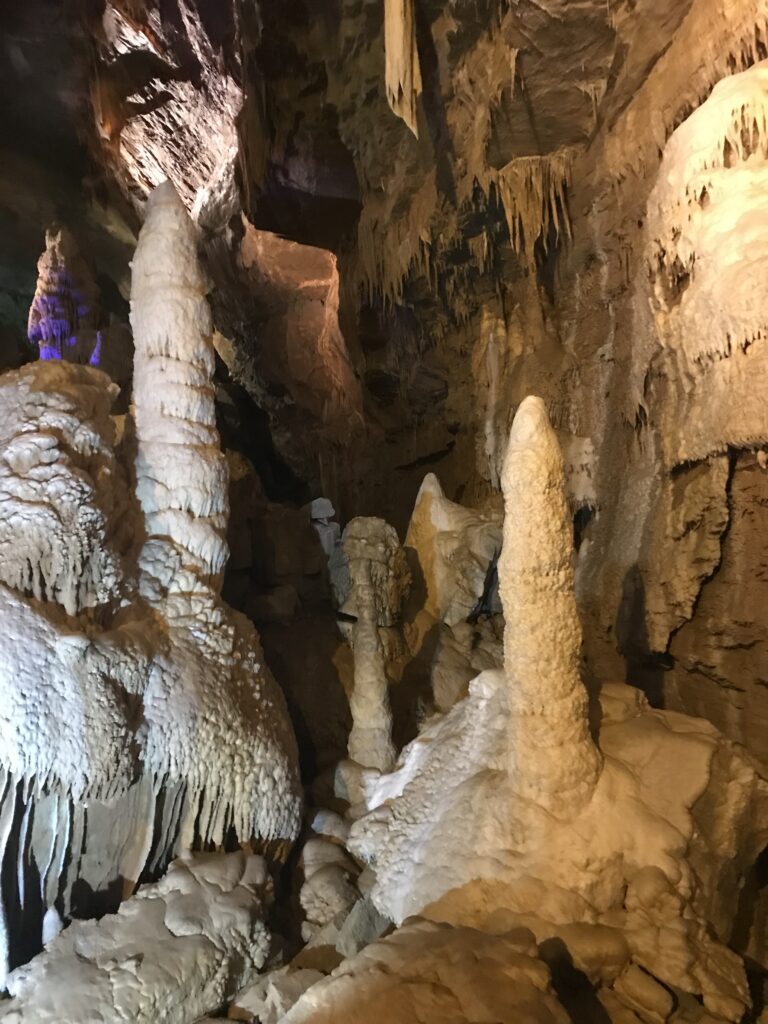
West Virginia is made up of limestone in some parts. Over millions of years, water has dripped through this rock, dissolving it bit by bit, which has created the huge spaces we call caves or caverns. It’s like an art project created by nature where water is the painter and limestone is the canvas. The West Virginia Encyclopedia says that this is called karst topography, where water sculpts the land in all sorts of wild shapes. These caves maintain a year round temperature of about 52 degrees Fahrenheit, which is kind of chilly but perfect for making things like stalactites and stalagmites. Stalactites are those icicle-like formations that hang from a cave ceiling. Stalagmites grow up toward the ceiling from the floor of the cave. One way to remember how to tell the difference between the two is, “Stalactites hold tight to the ceiling, while stalagmites just might make it up there someday.” They form through the slow drip of water carrying minerals, which over time stack up into all kinds of pointy shapes. It’s like watching something being built in super slow motion.
HISTORY
The caves aren’t just cool rock structures—they have their own story to tell. Back during the Civil War, places like Organ Cave were extremely important. Saltpeter was mined there, which is a key ingredient for making gunpowder for the war effort [see Saltpetre Mining in West Virginia, by Peter Hauer in our Summer 1975 issue]. In a way, the caves helped decide who won some of the battles in the Civil War. Before that, the Seneca tribe and other Native Americans used these caves for shelter, storing food, and possibly spiritual rituals or ceremonies. Exploring these caves is like a walk through history.
During the 1920s, when making alcohol products such as moonshine was illegal, some people used the caves to hide their moonshine operations because they knew most people would not think to look underground to find them. The West Virginia Encyclopedia states that caves were perfect for keeping the illegal practices hidden because they had a natural water source built in and they were conveniently out of sight in the caves.
Some of the more well known caves in West Virginia are Lost World Caverns, Organ Cave, Seneca Caverns, and Smoke Hole Caverns.
Lost World Caverns in Lewisburg is like walking into a fantasy movie. It has massive formations, including one called the “Snowy Chandelier,” which is a huge stalactite. Bones from ancient animals such as bears have been found inside the cave which helps us have knowledge of what animals may have lived in or used the caves over the centuries. My family toured Lost World Caverns and my Dad came away impressed. My Dad liked how easy it was to explore the cavern and enjoyed taking lots of pictures of the different formations. Even though it was cold outside, he said the temperature in the cave felt pretty comfortable. Our family also enjoyed looking through the gift shop.
EXPLORATION
Organ Cave has over 45 miles of tunnels and is one of the longest caves around. If you like history, you will enjoy Organ Cave because of its Civil War connections, not to mention all the cool rock formations make you feel like you are stepping back in time as you explore the cavern.
Seneca Caverns and Smoke Hole Caverns are found near the famous West Virginia Landmark, Seneca Rocks which has been attracting visitors since the 1920s. They have towering rock formations that look like something from a fairy tale. They are also a reminder of the rich Native American history found in the area.
Stalactites are those icicle-like formations that hang from a cave ceiling and stalagmites grow up toward the ceiling from the floor of the cave.

All the caves are fragile and have delicate ecosystems. Groups like the West Virginia Cave Conservancy work hard to protect them. They make sure the caves stay safe for the underground wildlife that live there, such as blind fish and insects. They also teach people how to visit the caves safely without messing them up.
Going into these caves feels like an adventure. Some tours are easy with lights and paths, and some are hard, as you might have to crawl or squeeze through tight spots. The downside of having such cool caves is that a lot of people want to explore them, which leads to wear and tear. Scientists have begun using a new technology to map caves using lasers which allows them to create precise 3D models to help with research and conservation.
West Virginia’s caves are more than just a place to visit, they are a lesson in geology, history, and conservation. They show us how incredible the earth can be and remind us to take care of these places. So when you are in West Virginia, don’t just look at the mountains, look under them too, at the hidden world of caverns.


ELLA DUNIGAN
Dunigan, Ella. "The Underground World of West Virginia’s Caves ." Goldenseal West Virginia Traditional Life, Fall 2025. https://goldenseal.wvculture.org/the-underground-world-of-west-virginias-caves/