

Morgantown’s Tom Bennett Received the Medal of Honor for his Service in the Vietnam War as a Conscientious Objector
April 7, 1970 would have been Tom Bennett’s twenty-third birthday. Fourteen months earlier, he died in the Central Highlands of Vietnam while serving as a medic in the U.S. Army’s 14th Infantry. The Morgantown native was a pacifist who opposed the war in Vietnam. He received conscientious objector status but was still willing to serve in the Armed Forces.
Bennett’s twenty-third birthday would not be a celebration but instead a commemoration of his heroism in the face of mortal danger. Bennett’s family went to the White House, where President Richard Nixon presented them with Tom Bennett’s Medal of Honor.

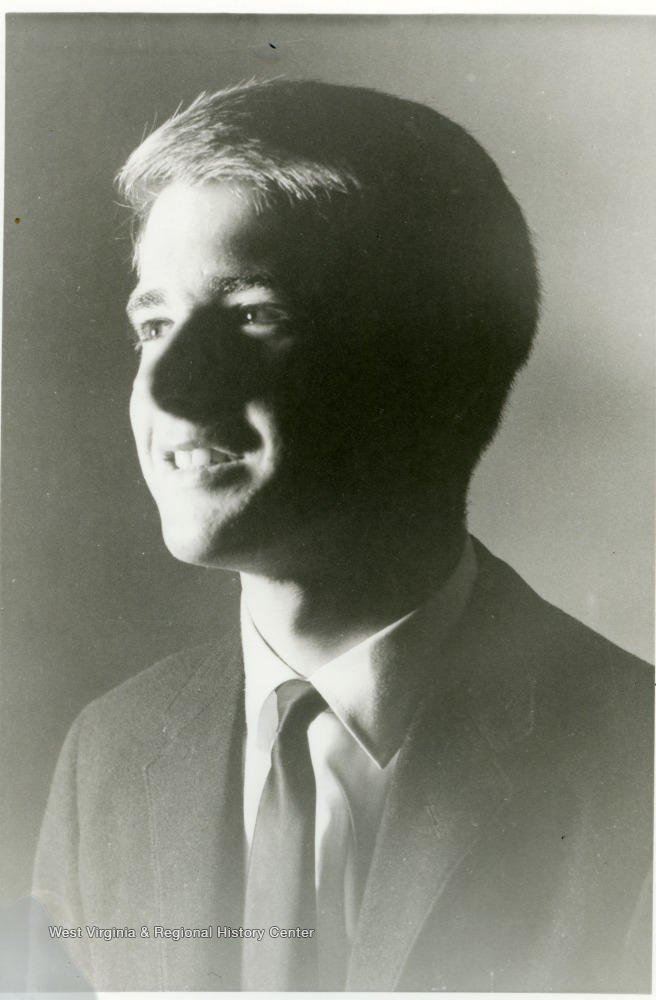
Photo Credit: West Virginia & Regional History Center
Bennett’s Medal of Honor citation celebrated his “conspicuous gallantry and intrepidity in action at the risk of his life above and beyond the call of duty.” For three days in the jungles of Vietnam, Bennett waded into the middle of combat, provided numerous wounded soldiers with first aid, and carried them to safety. On February 11, 1969, he succumbed to a sniper attack while aiding a wounded comrade who lay far beyond his company’s lines. For days, Bennett’s colleagues in Bravo Company warned him that his brazen acts of heroism could cost him his life. Bennett said he was just doing his duty. No one who served with Bennett forgot his sacrifice. His memory and the ideals he upheld have been enshrined both in Morgantown and in spaces across the United States.
Bennett’s combined commitment to service and to moral conviction put him in rare company. He became just the second conscientious objector to receive the country’s highest military honor. During World War II, a Seventh Day Adventist from Virginia named Desmond Doss received the award posthumously for his heroism as a medic in the Battle of Okinawa, which is depicted in the 2016 film Hacksaw Ridge.
Like Doss, Tom Bennett was a man of strong religious conviction. He was raised in the Southern Baptist Convention but embraced other churches as well, witnessing the divine and a path to human dignity in other religious traditions.
Thomas William Bennett was born in Morgantown on April 7, 1947, to Thurman and Gale (Miller) Bennett. Tom was the youngest of three brothers (George, Jim) in a moderately prosperous family. Thurman worked as an electrical engineer and the family resided in a large home on Junior Avenue. Thurman died of Hodgkin’s Disease when Tom was just five years old. Gale remarried two years later to Kermit Gray, a business manager and Naval veteran from World War II.
Tom grew up in a devout Southern Baptist home. He participated in Bible Study from a young age and started teaching Sunday School as an adolescent. He spent a decade in the Boy Scouts, advancing to the position of assistant scoutmaster for the Troop 68 Explorer Post based at Drummond Methodist Chapel. Bennett attended Suncrest Primary School and Morgantown High School. The wiry 5’6 Bennett was known for his energy and athleticism. In high school, he served in student government, reaching the position of class president in his senior year. He graduated in 1966 and matriculated at West Virginia University (WVU), located roughly two miles from his childhood home.
Bennett was active in campus life from the time he arrived at WVU. He served in student government and helped write the University’s first student code of conduct. He co-founded the Campus Ecumenical Council and served as the council’s president. He worked to find common ground among different religious groups on campus, a sensibility that appealed to many young people in the 1960s. While in college, he attended services regularly at several different churches in Morgantown. Bennett, like many of his contemporaries, viewed the life of Jesus Christ as a model for how to navigate the torments of the modern world.
Bennett spoke out frequently and fervently against the war in Vietnam, becoming one of the school’s best-known activists by his sophomore year.
“Oh God, during this time of crisis, help us have courage to face it, strength to endure it and patience to understand it. No matter what its outcome. Fill our hearts with your love,” Bennett wrote in a prayer that he delivered before a meeting of the Campus Ecumenical Council.
Bennett’s wide-ranging extracurricular activities clearly had an impact on his grades. After the fall 1967 semester, Bennett received academic probation, which made him eligible for the draft. He weighed his options, hoping he could find a way to both serve his country and keep to his convictions. Bennett did not want to dodge the draft or refuse to serve his country.
A childhood friend, David Kovac, had joined the Marines and was killed in Vietnam in 1965. Bennett refused to kill but also refused to avoid the duty taken on by friends of his like Kovac.
A campus draft advisor informed Bennett that he could apply as a conscientious objector who was willing to serve. Many other young men applied as conscientious objectors who were unwilling to serve. An estimated 170,000 young men received the latter classification. Most of them ended up working in hospitals or civilian public service. Roughly 10,000 young men received the same kind of conscientious objector status as Bennett, serving primarily as medics in the Armed Forces.
In May 1968, the Selective Service Board granted Bennett’s request to become a conscientious objector who was willing to serve.
Bennett was inducted into the US Army on July 11, 1968. The Army sent him to Fort Sam Houston, Texas for non-combatant basic training and field medical school, which prepared him to serve as a medic.
In letters home, Bennett assured his family that his chances of going to Vietnam were slim. It turned out that his entire field medical school class went to Vietnam.

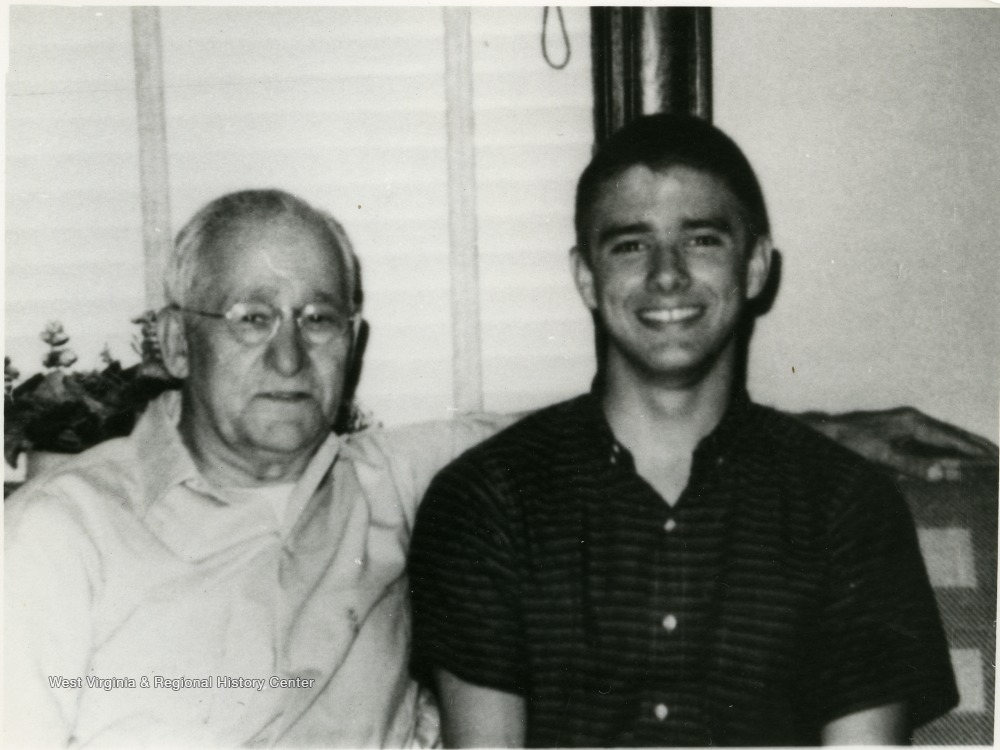
Thomas W. Bennett and Grandfather Floyd Bennett – Photo Credit: West Virginia & Regional History Center
After completing his education at Fort Sam Houston, Bennett took leave and celebrated Christmas with his family and friends in Morgantown before reporting for further duty.
He arrived in Vietnam in mid-January 1969. Bennett would spend just 26 days in Vietnam but left a permanent mark on the men with whom he served. He joined Bravo Company in the 1st Battalion of the U.S. Army’s 14th infantry, who were stationed in South Vietnam’s Central Highlands in Pleiku Province.
During his time in country, Bennett wrote letters and tape-recorded messages to send back to Morgantown frequently during his time in Vietnam, always reassuring his family that he was in a relatively safe place.
“I believe in America. I believe that our process of government can respond to people’s needs if each will assume his own responsibility. I will continue to serve within the limits of my personal conscience until I feel there is no longer any hope,“ Bennett wrote in a letter to his parents shortly before his death.
Bravo Company spent early February 1969 patrolling Chu Pa, an incredibly steep mountain covered in thick jungles and ravines. On February 9th, Bravo Company was working its way down Chu Pa when another company was ambushed by North Vietnamese forces. Bravo Company moved to support their embattled compatriots when they faced their own ambush. Three members of Bennett’s platoon were wounded almost immediately in an attack that featured automatic weapon fire, rockets, and mortars.
In the midst of a firefight, Bennett worked his way to all three of the wounded men, provided them with life-saving aid, and carried each man back to his platoon’s line. Bennett spent the remainder of February 9th checking on the wounded soldiers, providing them with treatment and comfort. In addition, he ventured out into no man’s land on two more occasions to rescue more wounded soldiers. MedEvac retrieved the wounded soldiers as the fighting calmed. Bennett’s comrades went immediately to their superiors and recommended him for the Silver Star.
On the afternoon of February 10th, the enemy hit Bravo Company with a new round of attacks, forcing Bennett to place himself in harm’s way on several more occasions to aid wounded soldiers. His fellow soldiers pleaded with him to show more caution, but he said he was just doing his job.
By February 11th, Bennett had been awake for most of the last three days, continuing to tend to the wounded who had yet to be retrieved by MedEvac. That morning, enemy forces hit Bravo Company with a round of Sniper attacks. Bennett aided one of several wounded men before venturing beyond the company’s position to rescue another wounded soldier. His staff sergeant told him that it was too dangerous to go after the wounded man, but Bennett worked his way once more into the fray. As he tried to bring his comrade to safety, Bennett was mortally wounded by sniper fire. He was 21 years old. His compatriots in Bravo Company would recommend him for the Medal of Honor.

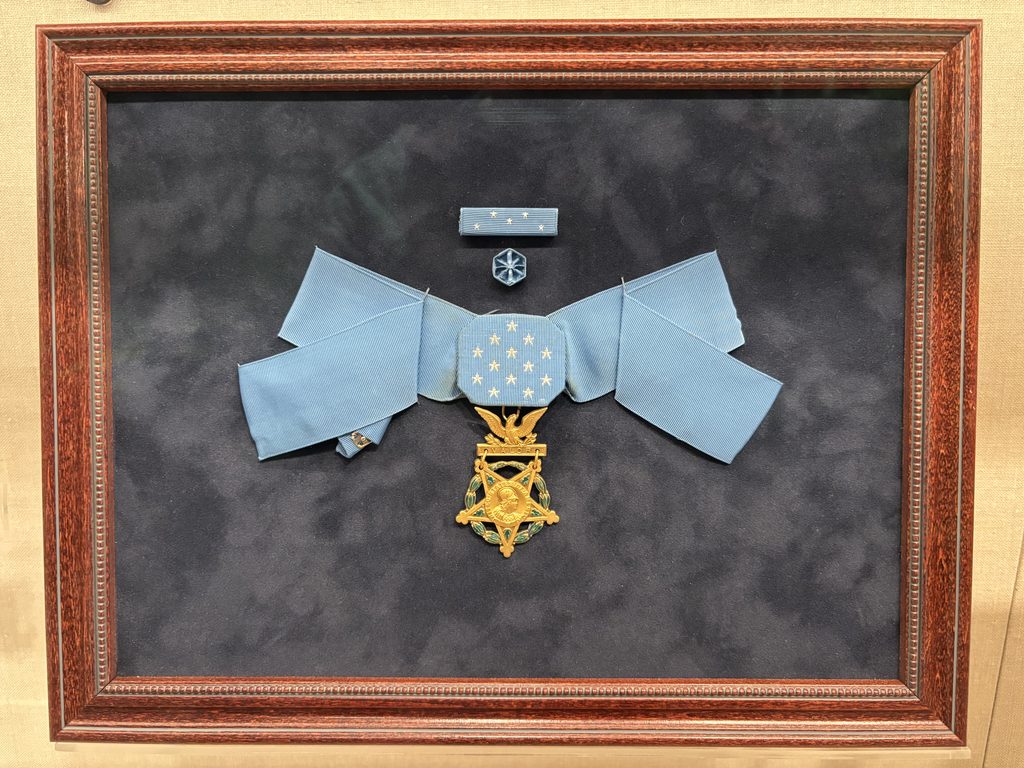
Bennett’s mother considered refusing the Medal to protest the war, but her husband convinced her to attend because it had been his comrades who put him up for the award. President Nixon presented the family with Tom Bennett’s Medal of Honor in the Oval Office.
“Corporal Tom Bennett’s undaunted concern for his comrades at the cost of his life above and beyond the call of duty are in keeping with the highest traditions of the military service and reflect great credit upon himself, his unit, and the U.S. Army,” read the final line of Bennett’s Medal of Honor citation. Bennett received a Purple Heart as well for the wounds that led to his death.
For several years, churches in Morgantown held memorial services in Bennett’s honor on his birthday. Long after American forces left Vietnam, people from near and far Bennett’s hometown honored his legacy.

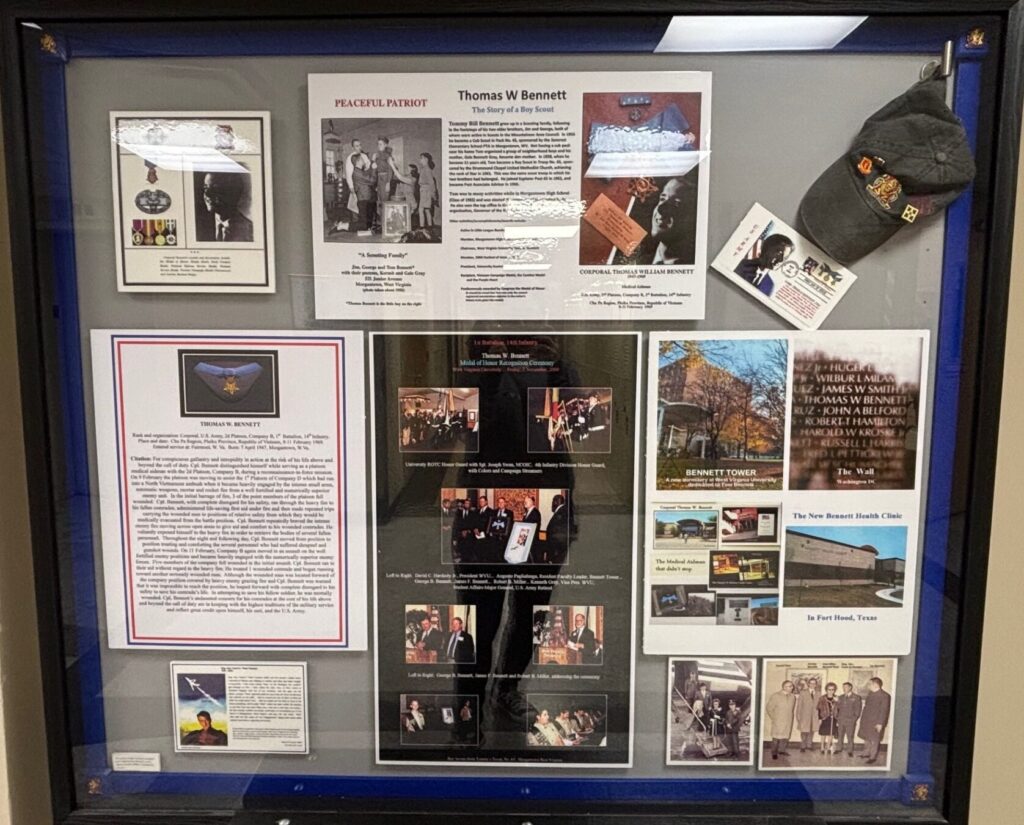
A youth center at the U.S. Army’s Schofield Barracks in Oahu, Hawaii was named in Bennett’s honor in 1988. The Bennett Health Clinic at Fort Hood, Texas, which opened in 1997, bears the Medal of Honor recipient’s name. Bennett Tower, a residence hall at West Virginia University, honors him on campus. His Medal of Honor is currently on display at the Neal Museum of Health Science at West Virginia University.
Bennett was buried at East Grove Cemetery in Morgantown, where he now rests alongside his stepfather and his mother, who died in 1981 and 1989 respectively.


About the Author
Clayton Trutor
Trutor, Clayton. "Undaunted Concern." Goldenseal West Virginia Traditional Life, Fall 2026. https://goldenseal.wvculture.org/undaunted-concern/