By Kathleen M. Jacobs
In the spring of 2022, The Daily Yonder published six short stories that would, three years later, be published along with a novella, The Harboring, by Jan-Carol Publishing. The title: The Harboring & other stories. It was the author’s first collection of short stories, that joined her other published work for young readers.
As the collection received impressive blurbs from WV author, Cynthia Rylant and the highly-acclaimed author, Amy Jo Burns, along with equally-impressive reviews from readers, enjoying a spirited launch in New York City, finding a place on the shelves of that city’s esteemed bookstore, The Corner Bookstore, Jacobs gathered comments from readers who found the work cleansing, as its core focused on the resiliency and strength of women, particularly Appalachian women. These conversations grew into a narrative poem that brought together the collection’s characters to suggest that it was time—past time—to shed the old and prepare for the new. The result: “The Molting Season.”
THE MOLTING SEASON: A Narrative Poem
By Kathleen M. Jacobs
Stage Road
Memphis, TN
1955-1965
The four-room clapboard (from the Dutch word klappen, “to split”), sat on a knoll,
the heavily trafficked, two-lane road at its base.
On one side, Eddie’s Service Station; on the other, a dilapidated,
three-story Victorian in shambles—three years after it caught fire,
the family of five, asleep inside, not recovered, not even a charred bone.
I stayed between the two, safe as safe can be on the grounds
of the white clapboard house, Eddie peeking at me, winking
through the honeysuckle brambles, Lila’s chestnut-colored skin radiating
off the early morning sun, standing like a sentry, cast in bronze.
Two black and white photographs propped against empty Coca-Cola bottles:
Easter, 1960. I’m five years old, wearing a frilly Easter dress, shiny
black patent leather strap shoes, and carrying a full Easter basket
of chocolate bunnies and jelly beans and purple dyed eggs with my name etched
in bright yellow, my father scrunched beside me, knowing what I had not yet been told.
Christmas, that same year, he’s alone in this photograph, sitting in an upholstered,
floral print chair, beside a fully decorated Fraser fir, lights blinking, silver tinsel
waving from the heating vents, and a lopsided five-point star at the top. He leans
forward, bent at the waist, hands clasped, face drawn. I wonder why I am not on his knee.
Years later, I can hear his voice beckoning, in a loud whisper, “Kathy, come here. Kathy, come
here.” And I look all around me, but he’s never there, only his certain, intoxicating voice,
and I carry it with me everywhere. It flows steady, like the drips of water from our kitchen sink.
Cologne Avenue
St. Louis, MO
1965-1966
Walking through Cristy Park, passing by The Corner Grocery,
where, on my way home from Our Lady of Sorrows School, I stopped
to buy Chick-O-Stick, I turned to look back at the red brick bungalow
on Cologne Avenue, fearing that if I didn’t that it would disappear.
Its peaked roof tapped the sky, its heavy, wood cathedral-style-top
door with its brass mail slot, opening wide to let me in.
The worn Aubusson rug that carpeted the dining room anchored
a pink velvet sofa, which faced the sidewalk, Johnny’s Tavern across
the street, the neon Schlitz Beer sign mesmerizing. Every Sunday morning, I rushed
outside to gather the treasures that had been dropped by revelers, by those in despair,
as they searched for their car keys: shiny copper pennies, mints, Cracker Jack prizes, gum
wrappers and comic strips, a pocket watch, a penknife, stamps, and once, a dollar bill & once, a
holy card, the Virgin Mary and Child in repose, behind them a waterfall. Each of these I kept in
an old cigar box that belonged to my father.
Inside, in the small entryway, hung a portrait of my mother
as a young bride, even after she divorced my father, even after he wielded
a carving knife and she a discharged pistol. Even after we were awakened
during the night to witness a shadowy figure on a step stool, slathering
mustard mixed with water on the kitchen walls.
Orchard Avenue
Fayette County, WV
1966-1976
App-uh-latch-uh or
App-uh-lay-shun
At first, it didn’t matter; over time, it did.
Approaching West Virginia and Fayette County hemmed us in even more than being hemmed
in inside my mother’s new husband’s scarlet Buick—eight hours of grieving
for what had been left behind. Its replacement: soaring, verdant mountains
on each side and a roiling river between them. And then one unincorporated town
after another, connecting the dots on a child’s worksheet.
Climbing the steep hill that led to Orchard Avenue and our ranch style, white
sided house was in stark contrast to Stage Road, to Cologne Avenue.
A fireplace in the family room, floor-to-ceiling windows ran across the back of the house,
exposed beams at the ceilings that joined the living room to the dining room, and bedrooms
with en-suites. And over time, shifts in the foundation and cracks in the walls and ceilings and
wet basements: metaphors that I yearned to bottle up and watch bob on their journey along the
crystal clear waters of the creek that ran steady in the wooded space across the street—one
that would never yield a healthy harvest. The only saving grace: the certain appearance
of the silver, shiny Fayette County Bookmobile that parked in front of the Methodist Church,
a half-mile walk from Orchard Avenue in an unincorporated town that questioned
the very definition of town, opting instead for village, even though, when mentioned,
garnered suspicion.
The years moved at an agonizingly slow pace, one melding into the next,
my own portrait as a young bride hanging in the entryway, above the television
in my own house, thirty miles west, but in my mind, across the country, as I left
behind the man my mother married, after he demanded that my long hair be pulled
back into a ponytail before sitting down to a meal; escorted me, as I walked on my knees
to my room, through the family room, the kitchen, the hallway and back out again
through the same route, when I refused to remove my shoes to retrieve a notebook
(because shoes were never allowed inside the house); after he raised his right arm to strike
me when I refused to stop practicing a clarinet piece in preparation for a concert;
or after the night I heard him shout to my mother, “Now I know why he left you.”
She remained silent, until she didn’t. And that’s when I knew it was time for me to leave.
Years later, my mother said that I got married far too young for those reasons alone, and maybe
she was right. Maybe she was right.
Stark Street
Kanawha County, WV
(one county west of Fayette County)
1976-1981
The Cape Cod, with its ten-foot-tall evergreen tree in the front yard,
decorated with strings of multi-colored Christmas lights that, once wrapped,
stayed wrapped, sat at the corner of an unnamed street and Trapp Avenue,
thirty miles west of Orchard Avenue. We named it Stark Street for delivery
purposes and because it was, well, void of anything to conjure a more inviting
moniker. The town though was incorporated.
The hillside to the right of the house was overgrown with a thicket
of intertwined brambles that resembled vines around a tree, tree roots,
snakes wrapped together. Setting it to fire resulted in a charred landscape.
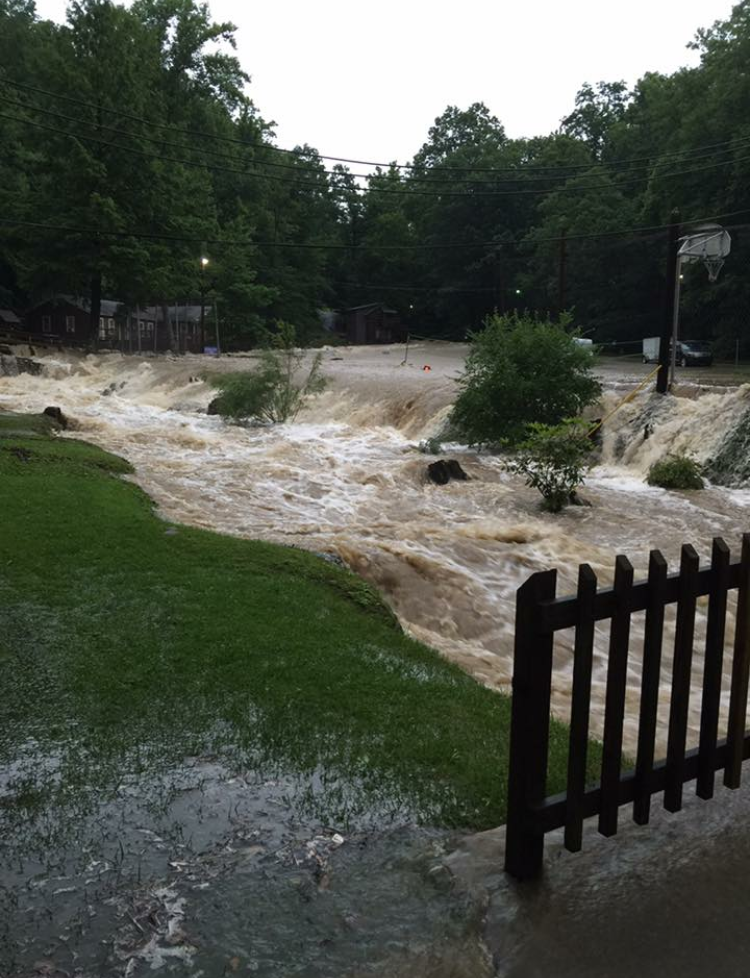
A one-lane bridge butted the hillside, and a creek ran behind the property
which, during a heavy rain, inched its way to our backyard, saturating the ground,
until it seeped through the porous block walls in our basement until we donned
rubber boots and a push broom to send it back to the creek, until the cycle repeated
itself. Still, the portrait hung above the bright lights of the television screen, a bouquet
of wilted, white roses discernable through squinted eyes.
Trapp Avenue
Kanawha County, WV
(one block east of Stark Street)
1981-1990
Its redwood exterior was peeling; we’d find bits of it on our front porch,
on the hood of our Ford Fairlane, seeming to meld the colors, sprinkled
on the tops of our peonies, falling to the ground when a breeze wafted.
Inside, the Hummel figurines shook on the shelves of my corner cabinet
as over-loaded coal trucks sped by, leaving a fine coating of dust particles—
everywhere.
We wallpapered the kitchen ceiling in Schumacher’s “Wild Strawberry”—rolls
left over from Stark Street. The wood-burning fireplace in the sunken family room,
like us, lay dormant: “a state of suspended animation, where something isn’t functioning
or showing activity, but isn’t gone, just temporarily quiet.”
His stoicism was in full view the morning he opened the mirrored closet door
and a corner of glass dropped, piercing a vein on his left wrist, dots of carmine red
blood making a pattern on the snow white, wall-to-wall carpeting.
The heavy rains followed us to Trapp Avenue and continued to flood
our new walk-out basement, until we let them recede on their own.
Kanawha Boulevard
Charleston, WV
1990-present (with detours)
“April is the cruelest month.” T. S. Eliot
Words used on our “We’ve Moved” announcement cards, followed by:
“This city girl finally convinced this country boy to move, well, to the city,”
completely unaware that those we had left behind found them offensive.
Kaa-nuh-waa or
Kuh-naw–uh—the latter being the common local West Virginia way. It’s both a river
and a county in West Virginia and with a name coming from a native American
word meaning waterway.
The six-story, red brick building at the corner of Kanawha Boulevard and Brooks Street,
offered east and west facing balconies with sweeping views of the Kanawha River, sans water
intrusion. We left rubber boots and push brooms in the trash heap when we sold Trapp
Avenue’s redwood house.
Still, the coal-bearing barges traveled up and down the river, revelers on speedboats waving,
and the Amtrak announcing its power at the crossing on the other side of the river, knowing
by its marked flood levels that it too calls its own shots.
It’s in this space that we will break the no-pets allowed policy and sneak in during the dark of
night three finches—doctor’s orders—in an attempt to heal from a bond that turned traumatic.
Their names: Atticus, Boo, and Jem. For two years, until I woke to find them at the bottom
of their cage, they restored my health with their sing-song melodies.
****
One dark winter evening, as the sun bid farewell, the telephone rang—a landline mounted
on the kitchen wall; the conversation brief, incredulous. Years later, after reliving that moment
again and again, I would recall the scene from Breakfast at Tiffany’s when Holly Golightly
receives the devastating news that her brother, Fred, has died. Dead, died, gone. Dead, died,
gone. The words, once spoken cannot be retracted, even when all that resounds is, “No!” “No!”
“No!” And the feathers scatter, even when they have settled.
As we returned my mother’s body to where she (and I) began her life—St. Louis—we stood
listening to the words Father spoke with such conviction that we too had no choice but believe:
“Father forgive her any sins she may have committed, for she did what she thought was right.”
And as we left Saints Peter & Paul Cemetery, the sun shining bright, seeming to move along with
us, I heard myself say, “Slower. Please drive away slower,” as she became a mere shadow on a
wall that would, in time, disappear, leaving faint traces of her everywhere I went.
Detours
1990-present
Southwest Virginia
One melds into the others, becoming disentangled, inseparable, and I long for the finches
to be returned to their wire cage, comics carpeting its floor, wooden dowels to flit
manically about, and plastic toys to amuse, the tinkling of tiny, tarnished bells, resurrected.
****
The two-bedroom, one bath rental was peaceful, until it wasn’t. The guest room’s closet doors
were intentionally untracked late one evening after returning from a performance at the Barter
Theatre—one whose recollection doesn’t even enjoy a thin fog, even as the faint fog outside
barely led us home. The collapse of the paneled door invited an escape, a three-hour
return trip home to a space that could never be called home.
Returning the following day to a closet door that had been re-affixed, removing—
at least visibly—what the prior night had revealed, began the journey back
and the start of yet another cycle that would never experience cessation,
even as we returned dodging drops of rain and snow, sleet and ice, and the blazing, scorching
sun, the fallen leaves cushioning our own descent.
****
Late night exits lessened, but did not cease.
Driving an opened Solstice at midnight, while freeing, eventually ends, driving
along the twists and turns of Rt. 60 and Hawks Nest Mountain,
where I parked and gathered a drawstring bag of jewelry:
rings and necklaces, bracelets, and earrings and with a firm conviction,
tossed them from the park’s overlook, shedding what had yearned
to be released for so very long, inhaling and exhaling the years
that had passed with a vehemence that until that moment
had been kept at bay. I continued west, the only car on the road
that would lead me back, not home. But I had started the final
journey, and a slight grin immerged, as I listened to Hennie Bekker’s
“Letting Go.”
New York City
The throngs of people.
The deafening sounds from the throngs of people, shouting, “Taxi!”
The ambulance sirens, the police car sirens. The throngs of dogs
and their obnoxious, self-absorbed owners insisting on three-fourths
of the sidewalk, unclear as to who is walking whom, yet crystal clear.
The excrement from the canines whose walkers refuse to obey the clean-up
signs is one reason why the throngs of people seldom look up at the blue
skies, the billowy clouds, instead looking down, weaving and bobbing,
like a carnival game along the midway, making every attempt to avoid
the unpleasant droppings. And the steady stream of marijuana fumes waft
through the throngs of people, as the scales tilt in the wrong direction.
And then there are the pigeons of New York City—the throngs of pigeons—
leaving their own mark everywhere. Some see this mark as one of good luck—
I’m not one of those people, but I do like the stories about NYC pigeons
penned by E. B. White.
All of the unpleasant markings left throughout the city are juxtaposed against
Museum Mile, Grand Central Terminal, Rockefeller Center during the holiday
season, and Patience & Fortitude guarding the entrance to the New York Public Library.
Still, the scales are out of balance.
Our shoebox apartment accommodates one upholstered sofa and one bed and one chair and one
table and two early etchings by Isabel Bishop, showing a NYC shopgirl reading
a newspaper and the other, two girlfriends—a homeless man sandwiched
between them—gossiping on a park bench. And while the furnishings
are sufficient—perhaps even more than sufficient—we’re still searching
for “those lovely intangibles,” knowing that they were always there; we
just kept finding substitutes that never delivered and never would.
Returning (alone) to Kanawha County
Lee Street
This time it was our first joint decision; he remained on Lexington Avenue
and I returned to West Virginia—this time three blocks west to a historical
bank building recently converted to residential apartments. A new sofa,
an upholstered chair, a bistro kitchen set, a credenza, a single bed, and a grass
green writing table. Large windows overlooking a triangular green space.
Within walking distance of a post office, a candy/nut shop where they sell
Chick-O-Stick, a pizza parlor, a library, a farmers’ market, a hospital, a bookstore,
an ice cream parlor, an antiques shop, an art store, a café whose Belgian waffles far exceed any
other Belgian waffle I’ve ever tasted. Every single offering void of dog excrement, throngs of
people, and those New York city pigeons, the sky so blue among the billowing clouds.
And there I remained, until it too met with a cleansing that began with a main line water break
that would sweep away—as if mere feathers shed in a molting season—all that had been
amassed, in order for me to move on to what lies ahead—the anticipation of what
lies ahead.
And still the mighty Kanawha River and the Kanawha Boulevard stay
tucked away, along with too many others, the key to each on a chain, worn around my neck,
making certain that it stays there, as I wonder what is yet to come, looking to those blue skies
and billowing clouds for direction.
The Denouement
Stacks of cerulean beribboned letters, shredded.
Diamonds’ blinding brilliance shattered at rocks’ edges.
The bobolink, silenced.
Still, I strain to hear the sweet notes of hope.

Kathleen M. Jacobs
Jacobs, Kathleen M. “WEST VIRGINIA: Shedding the Old, Preparing for the New.” Goldenseal West Virginia Traditional Life, Spring 2026. https://goldenseal.wvculture.org/west-virginia-shedding-the-old-preparing-for-the-new/