By Barbara Burton Grigg
This true story from the 1960s is a cautionary tale for today. You never miss the water ‘til the well runs dry, the saying goes. A figurative expression, even more compelling because it’s also literally true. This was the same decade that birthed Earth Day. May today’s Powers That Be see it as a prophetic warning. But aren’t those who don’t learn from history doomed to repeat it? Someone famous said that, I think.
Fifty-some years ago, Athens (Mercer County) was the kind of lazy Appalachian college town where signs in grocers’ windows read “We kill fresh meat.” An island of culture in the surrounding rural sea, Athens was home to professors and other natives who formed the college maintenance force. In the Fall of 1968, Concord College (now University) buzzed with typical pre-Homecoming activity. Even as the outgoing mail carried thousands of alumni invitations and orders for float flowers, no one noticed the water turning pink.
The next week, Vietnam War demonstrations synchronized nationwide on similar campuses. At Concord a handful of marchers circled the library’s stone steps to hear an unpolished ex-Marine speak from first-hand experience. WHIS-TV from Bluefield trudged over the mountain to record the event for posterity, and classes resumed as usual. By that night, the water had turned orange.
“The available supply of water in the existing system, and the capacity of the distribution system under conditions of abnormal demand, are no longer adequate. We have for the past three years been forced to suspend operation in October under chaotic conditions because of the recurrent water crisis.”
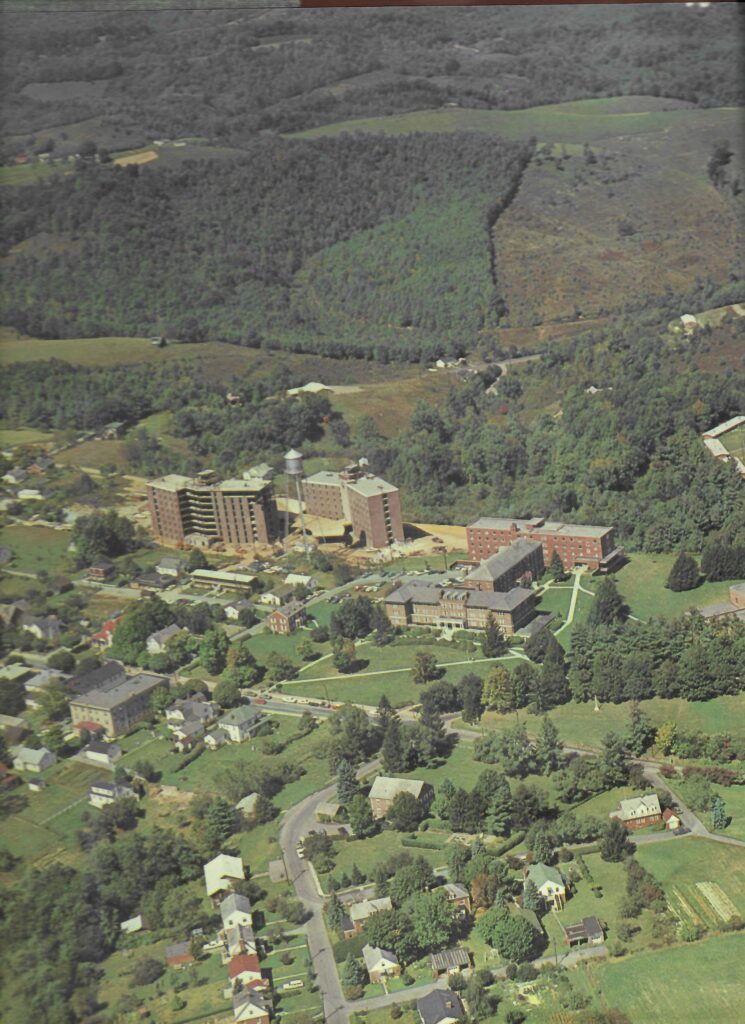
Pictured: Aerial view of Concord Campus, 1968.
Three weeks until Homecoming: Fraternities droned with posters and parades and campaigning. The newly formed Black Student Union, some twenty strong, took up sticks and drums to proclaim their Homecoming candidate. One night they danced across the wooded campus past plantation-style housing to the newer twin tower dorms clinging stubbornly to the rim of a cliff. As they wound their way through the canyon between the twin buildings, their song rose like the smoke of a war party’s fire. Then from the sixth floor, in a cloud of laughter and applause, a trash can full of water fell on their parade. By now, that water was brown.
Observant students noticed this. Some began to ask questions, and received reasonable answers. It hadn’t rained for over a month. Enrollment had increased this term. It should start to snow soon, and then the water table would rise and the brown silt again sink to the undisturbed bottom. Relax, they were told. The faint odor of rotten eggs filled the air.
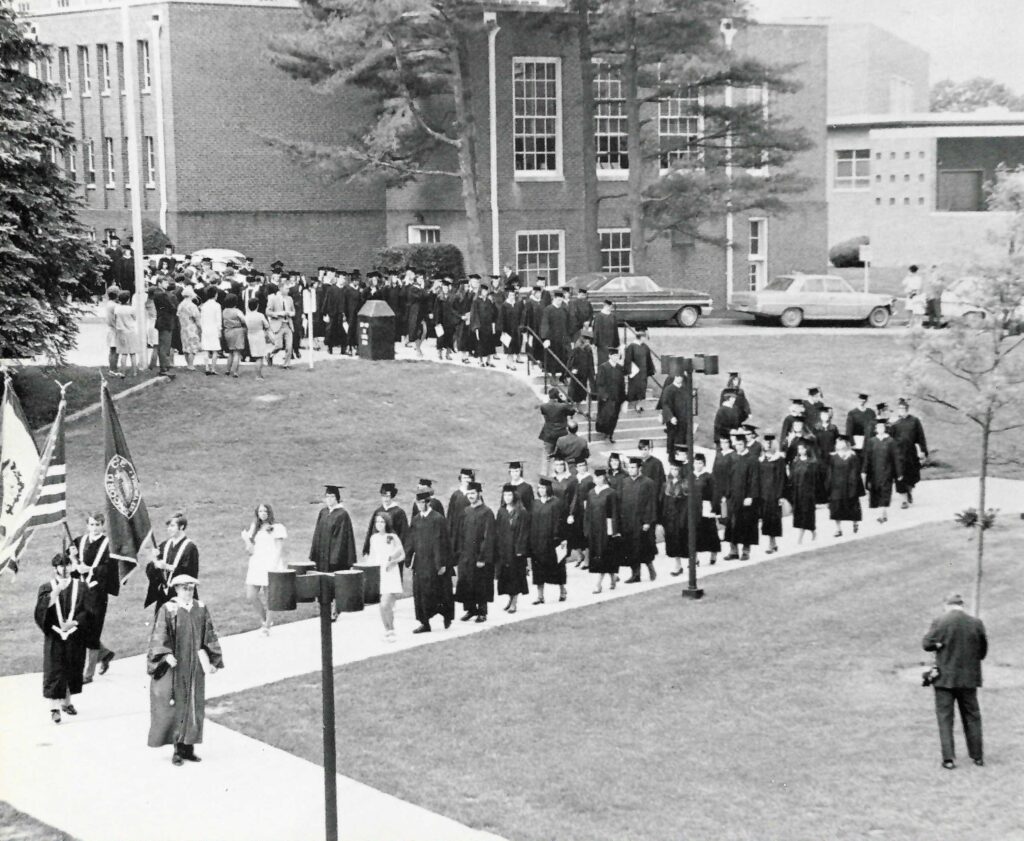
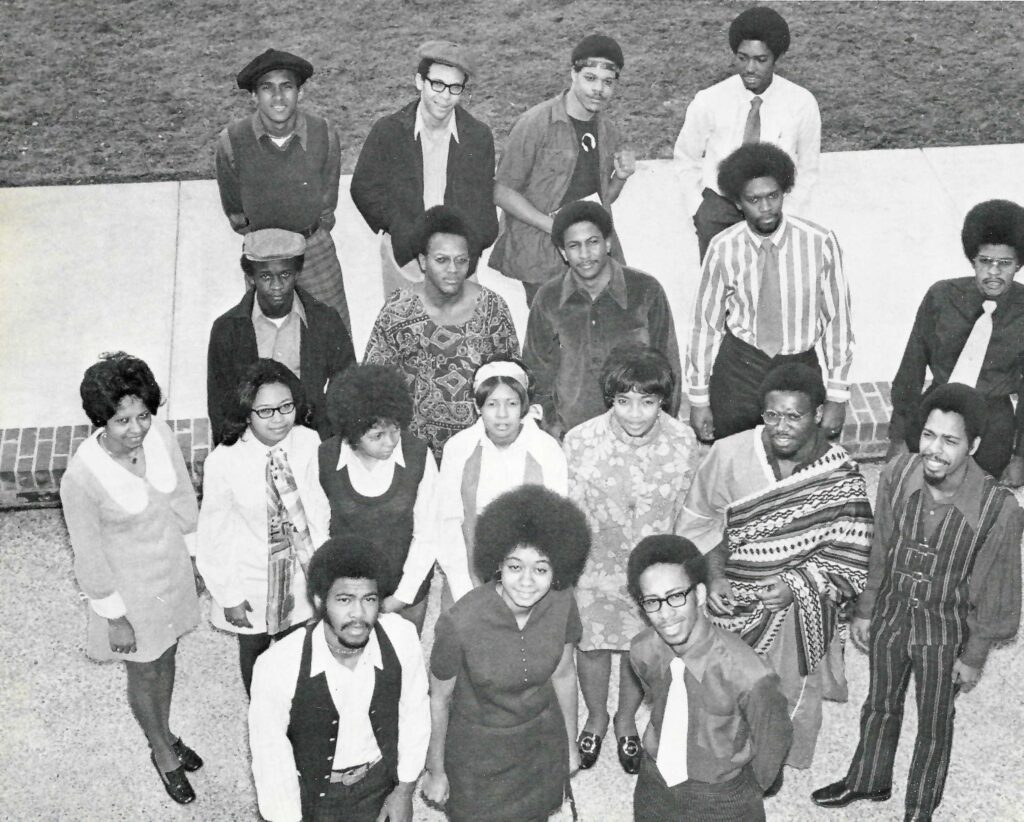
Two weeks before Homecoming: The townspeople moved to ration the use of their water to the college. So, the cafeteria began using paper utensils instead of dinnerware. Gradually, hamburgers and hot dogs replaced fresh vegetables and soups completely. As a further step toward conservation, students were asked to substitute milk for punch for all but one glass per meal. But no one did. Instead, they threw more beer parties off campus and continued to steal ice from the cafeteria to cool the kegs.
Ten days before Homecoming: When I went to do my laundry, I quickly changed my mind. The wet twists that strung from the washers and fluffed out of dryers were burnt egg-brown. Students flocked to the one local store, which could no longer keep a stock of sodas and juices.

A selection of official correspondence retrieved
from Concord Library by way of inquiry to Concord Alumni Association, April 2024.
1969 Student newspaper article regarding Water Break.
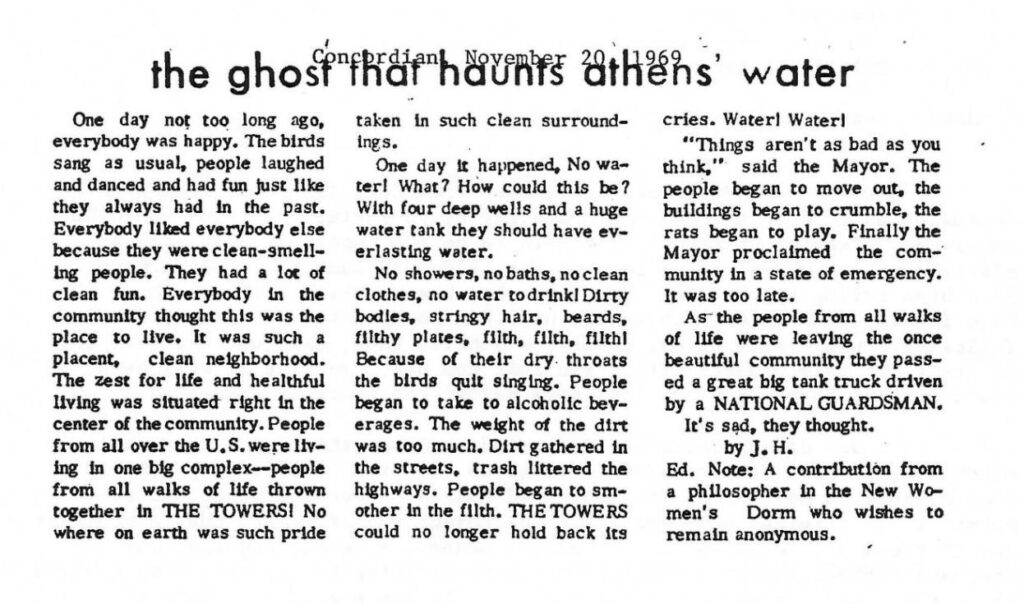
Feb 23, 1970 – President Joseph F. Marsh writes Administrative Assistant to the Governor
“As far as I can determine, very little progress has been made regarding finding any solution to the water problem in Athens. Many of the fears you expressed regarding delays and indecision have developed. Personally, I am completely frustrated…Not only do I fear that we will be faced with another shortage in August or September, but I also am becoming more and more concerned about the distribution system.”
Jan 12, 1971 – President March to Administrative Assistant to the Governor
“Because of the delay, it is quite obvious to me that we will have another water emergency sometime this coming August-November, and that the Governor again will be asked for special help for the Town and to avoid closing the college. . . As you can imagine, our students are becoming increasingly intolerant of the situation, and again are asking me ‘what’s being done’. . . Perhaps hauling equipment and manpower should be dispatched in advance and placed here on standby, when we have the very first indication that the water supply is getting low. I can think of no other alternative.”
Sept 21, 1971– Memo: Concord Business Manager
“Spoke with: (1) Mr. Roy Farley, Manager, West Virginia Water Company in Princeton, (2) Mr. John B. Murphy, President of the West Virginia Water Company, and (3) Town Council. Mr. Andy Fudge says he gets four or five days warning when water is going off. Tank truck is in Princeton. Town has new pump on deep well and extended casing down 35 feet. Consensus: Water will not be hauled in advance of emergency. Emergency will probably not occur.”
November 6, 1971 – President Joseph Marsh to Mr. Robert C. Stevens, Regional Director, Office of Emergency Preparedness, Region III
“The available supply of water in the existing system, and the capacity of the distribution system under conditions of abnormal demand, are no longer adequate. We have for the past three years been forced to suspend operation in October under chaotic conditions because of the recurrent water crisis. It is a situation which cannot be allowed to continue. . . Failure to build the new system will only perpetuate the loss of fire protection and sanitary facilities and general disorder which result from a loss of water.”
July 19, 1972 – Concord Business Manager Memo to all Administrative Officers, Division and Department Chairmen, and All Bulletin Boards
“Water service on campus will be interrupted on Friday July 14 from approximately 1-5 pm and on Saturday, July 22 from approximately 8 am to 5 pm. This is in connection with the installation of the new campus water loop. . . However, classes normally scheduled for Friday afternoon will continue as usual. All persons who will remain on campus during the above periods should take appropriate advance precautions.”
October 19, 1972 – Letter from Marvin E. De Bower, Vice President for Academic Affairs, Dean of the Faculty, to All Faculty. Subject: The Water Situation
“At about 7 pm last night, we were notified that the Town was cutting off the water to the College because there seemed to be a drop in pressure. The assumption was that students were wasting water. The Town has a legal right to take such action. . . A number of us, including the faculty Water committee, the Student Government Association resident and Vice President, the Concordian Editor, the Director of Student Affairs, the Deans of Women and Men, and the Executive Assistant to the President met in my office. Our best and most reliable information from the residence halls indicated that there was no significant (if any) misuse of water by students . . .There were no verified reports of student misuse of water. Many were conserving water, deferring washing their hair and other chores that could be delayed.”
September 4 1973 – Concord Business Manager letter to Mr. H. A. Chambers, President, Southern Erectors, Inc., Princeton WV
“As you probably know, a new water system is to be started soon for the Town of Athens, and it will be at least a year before it is in service. . . We expect also at a future date to be demolishing the old gymnasium and swimming pool and hope you might be interested in bidding on them, too.”

One week until Homecoming: The town of Athens enlisted the National Guard to transfer water by tanker from Princeton, nine miles away. Local newspapers and broadcast media picked it up. Students paired with friends who lived nearby but out of curfew range, to visit their homes to take a shower. I bought some Gatorade in hopes of quenching my cells with added nourishment; a kidney infection soon revealed I was allergic to it.
Five days until Homecoming: Commodes no longer flushed, only choking in an attempt to perform their duty. Water was available for two hours each morning and evening. Upper floor rooms couldn’t get it even then—no pressure. So, residents all flocked to the basement apartments to borrow their neighbors’ showers. Everywhere the floors were sticky with spilled cola from overrun garbage cans. Flies buzzed around the refuse; custodial usage had been suspended first. Commuters brought water from home in plastic jugs. Men grew beards, the women’s armpits caked with hair and old deodorant.
The Wednesday night before Homecoming: Students rallied on the President’s lawn. Gone was the clamoring for certain queen candidates, the thrown water and angry words forgotten. The mood was one of common destiny. Even the quietest students stood barefoot, stinking, probably constipated, demanding a solution to the crisis. The President strode onto his porch, well-groomed, calm and clean shaven. He assured the rabble of fountains flowing by Friday. You see, with Homecoming that weekend, they’d made so many plans they’d like to see through.
Two days before Homecoming: Water was turned off completely for thirty-six hours. Tempers flared. As they found it necessary, people shared the bushes with dogs. There was no longer anything anywhere to drink. Faces bent over water fountains out of habit, only to curse as people were snapped back to reality by dumb spigots.

Friday morning: Groups huddled in bathrooms, awaiting fresh water pumped from National Guard trucks miles away. Choke, gurgle, spit, clank. Cough. Finally, water flowed! Ecstatic, pairs and trios jammed shower stalls to share the long-withheld wealth. The deluge lasted almost six minutes. Then too soon, the supply was exhausted and drought again descended. Homecoming was the following night.
As wet, still grimy bodies emerged, chilled from the showers, the PA system announced at full volume: “Classes are temporarily suspended for one week pending replenishment of our water supply. They will resume Monday…” That was all anyone heard. Within minutes everyone was enroute somewhere for an unexpected extra vacation. In the end, most students were glad it all happened.
So glad, in fact, that after that Water Break became an annual event. For at least the next two years, students upheld the tradition by running showers and faucets constantly to bring on the disaster. Care was taken to coincide the Break with mid-term exams. Nothing short of expelling the entire student body could stop it.

BARBARA GRIGG
Grigg, Barbara Burton. “Concord College’s Water Break Tradition.” Goldenseal West Virginia Traditional Life, Fall 2025. https://goldenseal.wvculture.org/concord-colleges-water-break-tradition/