

By Jack Newhouse
I have been looking for country music performer Jackie Osborne in all the wrong places for two decades. I wanted to find out who he really was and if he made his mark on north central West Virginia’s country music scene. One barrier facing my efforts was that I was searching his career path by using his stage name because I did not know his actual given name. My first discovery was that he was born in the early 20th century at a time when country music was coming into its own. That is, the name country music was transitioning from hillbilly music because the latter tended to stereotype southern and Appalachian folks. Secondly, Jackie’s birth place was located below the Mason-Dixon line and that meant his roots were grounded in Appalachia.
The time of his birth coincided with the births of several individuals who would become his country music peers. Now, after a great deal of effort, I know that Jackie was born to Ray Jackson and Hilda Mabel Osborne in 1924, in Grafton, Taylor County, West Virginia and that his parents gave him the name of Ray Taylor Osborne. Jackie was born a year after Hank Williams, Sr.’s birth. So, meander down memory lane with me as I discover that Jackie played the guitar, sang, yodeled, won a national contest, traveled with several bands.
By the time Jackie was a teenager, several country music pioneers were successfully making their way to stardom. Significant vocalists such as Tex Ritter, Jimmy Rodgers, and Roy Acuff were performing on the stage and the radio. In addition, important country music venues were gaining popularity. In 1925, Nashville was the setting for the Grand Ole Opry. Less than a decade after Jackie’s birth, West Virginians were enjoying country music from the “West Virginia Jamboree” in Wheeling, West Virginia broadcast from WWVA. This Ohio County station was a noteworthy beacon of country music. In just a very few weeks the Jamboree was hosting its performers at Wheeling’s Capitol Theater. By 1934, the Capitol Theater was operating for capacity crowds. Country music was on a steady roll.
“We all can be proud of Jackie’s career back in the heyday when country music was not only playing on local radio stations, but on every juke box in honky-tonk bars across this country.”

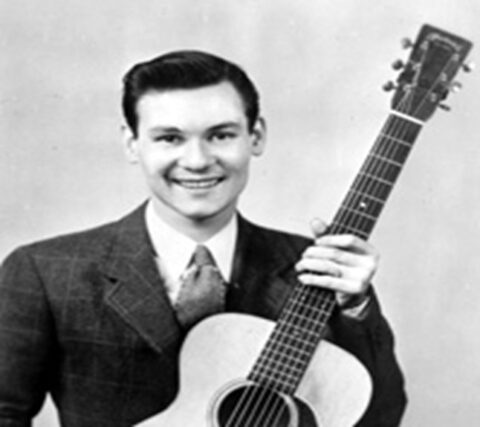
Twenty-six years after his birth, I saw Jackie Osborne perform with a band in 1950 when I was 11 years old. The venue was remarkably memorable because the only place available for that hometown performance was the courtroom at the Taylor County Courthouse in Grafton. Even more remarkable was the entrance fee. The cost to attend a live country music program that night was a mere 25 cents. Sometimes the tax was included for other productions and the cost of tickets for some shows did not exceed one dollar. How the performers survived on such bargain prices is truly amazing. Currently, the Grand Ole Opry costs over 50 dollars per ticket and the West Virginia Jamboree’s ticket fee for general admission is about the same. A third obstacle preventing my investigation of Jackie was because, while he performed with a variety of country music bands and he could be heard on several radio stations, there was scant information about his career. However, I was able to locate several photographs of Jackie, but even today there is a limited amount of narrative to report.
In 2017, I began to dig a little deeper to find out what had happened to Jackie’s role in country music. I had one slight bit of success when Jackie turned up in the encyclopedic-like tome Mountaineer Jamboree: Country Music in West Virginia by Ivan M. Tribe. Tribe’s work is a seminal source for historical matters related to country music in West Virginia. The book covers country music scenes from A to Z. However, Jackie’s name is listed just once along with country music pioneer Buddy Starcher’s “Sagebrush Round-Up” group. That minuscule listing did not describe any of Jackie’s special musical talents nor did it give a description of where he had performed. Thanks to an on-line website called Hillbilly-Music.com, I began to gain a greater insight into many of Jackie’s musical gifts. One entry stated that Jackie was a cast member on “The Old Dominion Barn Dance” on WRVA radio, located in Richmond, Virginia. This popular show was hosted by the nation’s first female master of ceremonies by the name of Mary Workman. Workman also went by the name of Sunshine Sue. Each Saturday night, patrons might enjoy Andy Griffith, Hawkshaw Hawkins, or Earl Scruggs on WRVA.
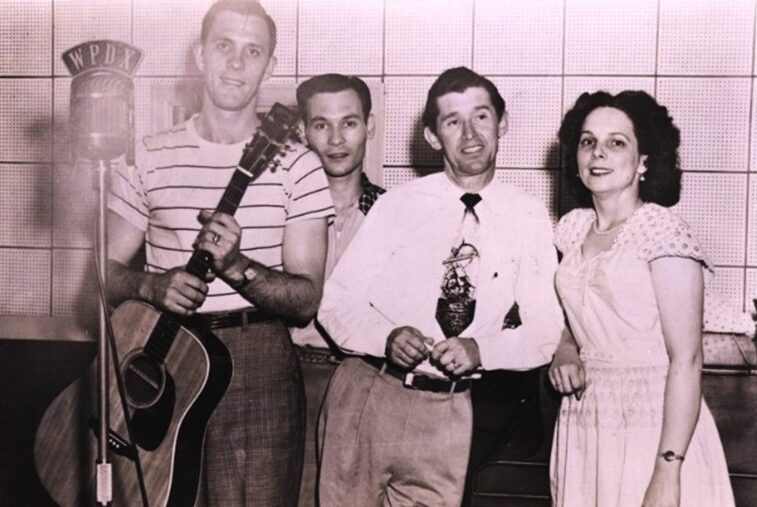
If a performer were signed to perform at this showcase, he/she could very well enjoy a big stepping stone to an even greater and more lucrative venue. As I was combing through more photographs from the early 1940s, I stumbled upon West Virginia University’s West Virginia and Regional History Center’s website. I found an undated photograph taken at WPDX’s radio studio in Clarksburg, West Virginia. That is Jackie in the background. The man nearest the microphone is West Virginia’s popular Little John Graham. The female is Graham’s wife, Cherokee Sue [see Little John Graham and Cherokee Sue: A Radio Love Story by Carl Feather in our Winter 2004 issue]. The man with the white shirt and tie is Roy Acuff. Acuff would go on to be christened the “King of Country Music” a couple of decades later and he became a mainstay on the fabled Grand Ole Opry. Acuff’s star quality talents awarded him a place in the Country Music Hall of Fame in 1962. Throughout his career, Jackie was either alongside or in the background of many of the greats of country music.
An Emerging Country Music Performer
Finding this particular photograph made my curiosity in Jackie’s career even more intense. Back in 1950, at the Taylor County courtroom, I was introduced to an array of strings that I had never heard live before. There was a comedian attired in a silly hat and coat who told jokes after each song. Having a comedic person was an important addition for most country music bands of that era. These change-of-pace characters were an integral part of what was typically a wholesome gift of hometown entertainment. Many of these funny folks became a famous face in country music in their own right. Minnie Pearl and Grandpa Jones were just two exemplary comedic mainstays of country music’s entertainment in the early days. That evening everyone in Jackie’s band sang along and took turns doing a solo bit. This brief musical interlude came my way because of Jackie’s younger brother, Richard. Richard was my playmate and his parents resided directly across the street from my home on East Wilford Street in Grafton during the mid-1940s through the early 1950s.
While I had not heard of Jackie before, tradition suggests that Jackie was singing at the age of three, yodeling by his ninth year and playing the guitar by his early teenage years. His tutors were the recordings made by the “Singing Cowboy” Gene Autry, and by watching movies that starred the “King of the Cowboys” Roy Rogers. These two stars were not only movie action heroes, they sang and strummed their guitars in most of those old-time western movies as the sun settled in the West.

Jackie also listened to recordings by Jimmy Rogers who became known as the “Singing Brakeman” and “America’s Blue Yodeler.” This was the era when front porches were lined by the homeowners, and neighbors would gather to sing and dance by playing their own versions of folk and country music. Chances were very high that a family member might be able to play the banjo, fiddle, or a guitar. Folk and country music were the prime entertainment means throughout Appalachia when Jackie was growing up in Grafton. It is not unusual, even today, to hear old-time music being delivered on West Virginia’s front porches. In the Depression Years, many families could not afford to purchase vinyl records as their musical source.
Early Radio Makes Country Music Popular
The rise in local radio stations made country music easily accessible for everyone. For example, between the late 1920s and the mid-1950s, West Virginians in the north central section of our state were richly endowed by having two key radio stations and Jackie performed on both of them. The premier station during those country music decades was WMMN radio in Fairmont, Marion County, located in the Fairmont Hotel. WMMN broadcasting began four years after Jackie’s birth in 1928 and within a decade, WMMN was presenting its own live country music shows. Roy Acuff may have shared his rising star voice at that location.
The surge in country music in the late 1930s prompted WMMN to initiate The Sagebrush Roundup on Saturday nights at the National Guard Armory. The innovative force behind The Sagebrush Roundup was Buddy Starcher who wanted to mirror a show similar to the live country music jamborees of that period. Starcher had a long and successful career in country music [see “Seventh Heaven”: Saturday Night at the Sagebrush Round-up By Carl Feather in our Winter 2004 issue].

The second important live country music radio production in the north central region was ushered in by WPDX radio in Clarksburg. That beginning was in 1947. Personalities such as Cherokee Sue and her husband, Little John Graham, were part of a group known as the West Virginia Hill Folks. Cherokee Sue would dress in a generic Indian get-up for most performances. That is, she wore a single feather headband and a buckskin vest. In other shows, she might be in a cowgirl get-up. By this time, Jackie had become part of the WPDX Hill Folks performers. It was the intent of WPDX to cash in on the popularity of live country music and to rival WMMN as best it could. A number of Fairmont talents came aboard and with the help of Starcher, WPDX enjoyed several years of live country music success. Later, some radio stations of that era soon began to drop the country music live production format. Nevertheless, small town radio stations were extremely valuable in their roles of spreading the hillbilly genre. Sadly, by the close of the 1950s, some live shows disappeared from the airwaves altogether.
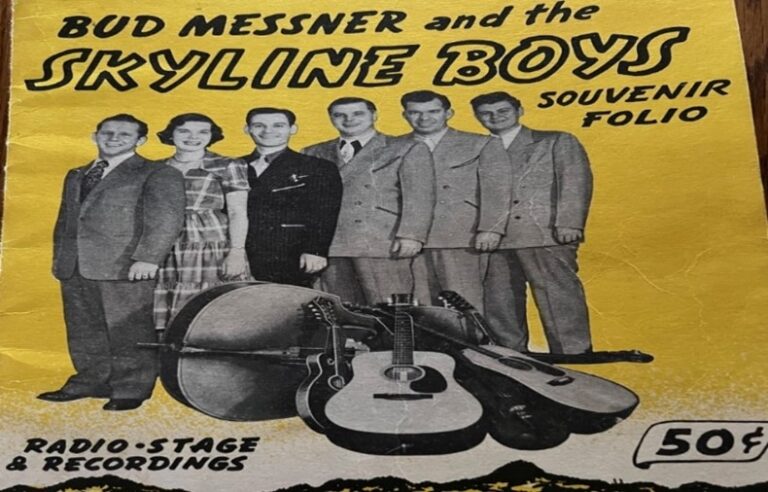
These local and national country music celebrities sometimes performed on WMMN and WPDX at no cost in order to announce their tours and introduce their new recordings. No doubt, Jackie may have announced his intention to perform in Grafton that night back in 1950 on one of those stations. Free commercial ads were just one means these musicians used to spread the word about their talents and performance dates. To supplement their meager incomes, performers peddled a variety of pamphlets called “folios” designed with stock photos, country song lyrics and summarized life stories. The costs were affordable as these souvenirs sold after each performance for 25 or 50 cents per copy.

On many occasions, when performers were off the airwaves, their careers were assisted by an amazing promotional character whom historians described as a country music con-artist supreme. They were referring to a P. T. Barnum-persona named Lawerence Sunbrock. Sunbrock would advertise fiddling, yodeling, and singing contests that were sometimes rigged and sometimes legitimate. Even though many of his marketing techniques raised questions about his integrity, he continued to be a prominent promoter of circuses, rodeos, and country music jamborees beginning in the early 1940s. Sunbrock always promised an extensive bombastic show and featured stars like Roy Rogers, Dale Evans, and Tex Ritter on a regular basis. When Sunbrock discovered that Jackie had placed in the top four contestants at a yodeling contest in St. Louis in 1942, which was not fixed, Sunbrock referred Jackie to Natchee the Indian and Cowboy Copas and encouraged that couple to sign Jackie as a partner.
Natchee was a trick fiddle player and is remembered as a stunning and flamboyant show person even though he did not speak very much during his gigs. Copas took a liking to Jackie and gave him the stage name of “Barefoot Ozzie.” Copas was a multi-talented country music personality that got his start in the 1940s at the age of 14. Later, Copas would continue his own career at the coveted Grand Ole Opry. When Copas replaced Eddy Arnold—another up-and-coming super star—in Pee Wee King’s band, Copas’ career skyrocketed. During this new opportunity with Natchee and Copas, Jackie performed at theaters and fairs across the nation. For some reason, Jackie did not perform at the Grand Ole Opry with Copas.
Good News for Jackie
In 1945, Country World Music ran a popularity contest about who the fans felt were the best yodelers. Amazingly, Jackie came in fourth behind Skeets Yaney, Tumbleweed Ludy, and the highly popular Gene Autry. Needless to state, the competition was strong. For example, Yaney had won a series of national yodeling competitions up to and after that time and was known as “The Golden Voice Yodeler.” Even at this time, Autry was a country music regular who performed professionally on radio and on the big screen. Jackie gained a notch in celebrity status with that fourth-placement win. During that era, country music singers and band members tended to flow from one group to another with relative ease.
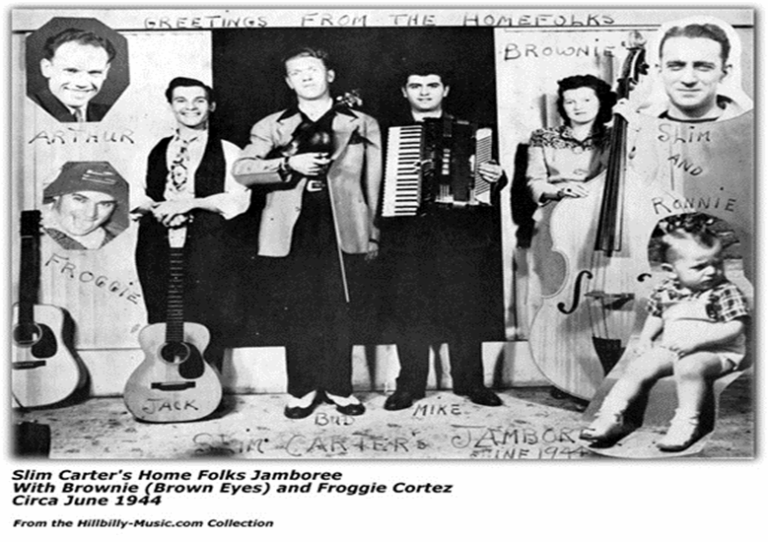
For example, from a series of historical photographs that follow, Jackie is pictured with Slim Carter’s Home Folks Jamboree. Carter later performed at the WWVA Jamboree. That Jamboree was called The World’s Original Wheeling Radio Jamboree and it had more fans in Ohio and Pennsylvania than in its home state of West Virginia. However, Jackie was not part of Carter’s production in Wheeling then. This was the second time that Jackie, for whatever reason, missed more critical fan exposure. Clearly a West Virginia frontrunner, WWVA was the very first radio station to be granted a broadcasting license in 1926. This legendary beginning meant that the Jamboree was the second country music radio initiative in history. The Jamboree drew an unbelievable audience of over 3,000 fans when it opened at the Capitol Theater. Ten years later, the Columbia Broadcasting System picked up the programming. This new entertainment was called CBS Radio Saturday Night Country Style. This was the first national program broadcasting from West Virginia to the nation. WWVA, like WWMM and WPDX, was a formidable source of country music and talent. Numerous regional and national talents burst forth from WWVA and the Jamboree.

When Starcher organized another band called the All-Star Round-Up Gang, Jackie was part of that group. Starcher began his country music career in 1938 hosting or performing in a variety of states including Louisiana, Maryland, Pennsylvania and West Virginia. In the group picture below, Jackie is in the back row second from the right.
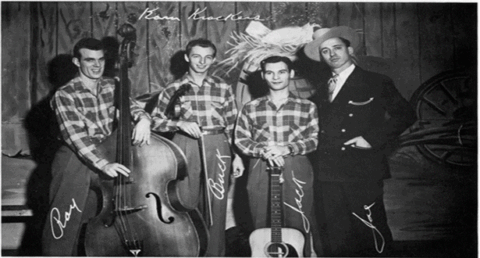
Jackie is also pictured with the Korn Krackers along with the King of Strings, Cousin Joe Maphis. Maphis hailed from Virginia and later resided in Cumberland, Maryland, where his father took a job on the Baltimore and Ohio Railroad. Maphis’ double neck guitar became his trademark. Another member of the Krackers was Ray Edenton (bass guitar). Edenton was a multi-talented musician who was from Richmond, VA. He is credited with assisting over 15,000 recordings during his career. In the 1950s, Edenton worked with the popular Everly Brothers. Although the Krackers were a well-received band, Jackie left the group to regroup and try his vocal talent as a recording artist.
In between gigs, Jackie was able to make a few recordings for Abbey Recording with another band by the name of Skyline Boys, led by Bud Messner, mentioned earlier.
The A side was called, “I Wooed Them, I Cooed Them, I Married in Tennessee.” The flip side was entitled “Paw Keeps Starin’ at the Shot Gun.” Messner’s band embraced a mixture of gospel and bluegrass, and recorded those tunes regularly on Abbey Records. The Skyline Boys played on WWVA radio and on television. However, when Messner and the Boys played that Jamboree, Jackie opted not to perform with the troupe. The WWVA Jamboree was likened to the prestigious and esteemed Grand Ole Opry. If you were spotlighted on the WWVA shows, you were more likely to be viewed as an up-and-coming star. Back in those days, fans marked their calendars and huddled around the living room radio to hear the new talents of the day.

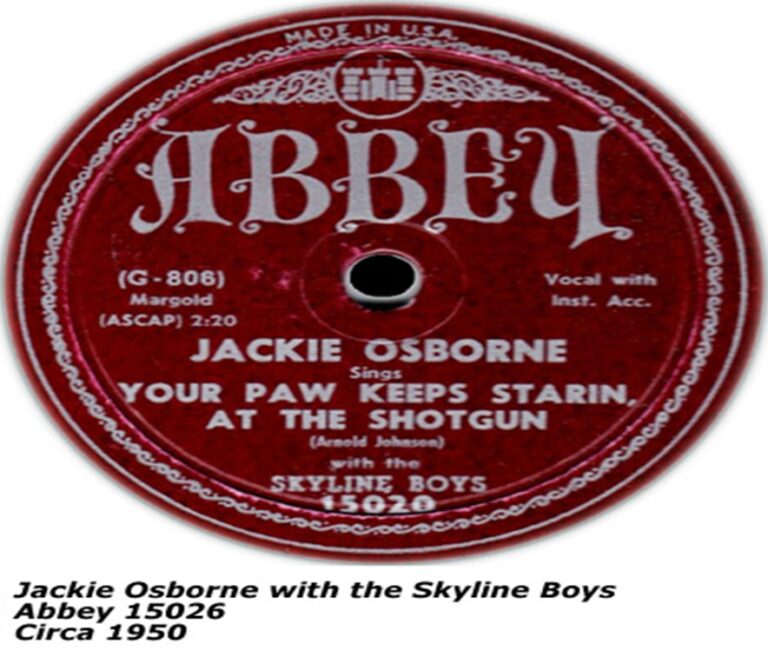
Jackie recorded two other songs on MARJON International Record entitled “Just a Pretty Girl” and “Why Not Play the Game” accompanied by the Nashville Sounds of the Silver Spurs. In addition, Jackie is credited on two other records made in Parkersburg, West, Virginia. The titles of those four songs are, “There’s a Fountain of Youth in the Sky,” ”Soon We’ll Be Going Home,” “The Glory Special,” and “For God So Loved.” I could not discover how well these recordings did state-wide, regionally or nationally. Thank heavens Messner published modest folios as a souvenir for his fans. Included in one of many of Messner’s souvenir folios are three photos of Jackie. In that souvenir, Messner writes that Jackie’s main instrument was the guitar and his voice was a baritone. He noted that Jackie got his start at the age of nine on a radio station in Akron, Ohio. Messner adds, when that folio was published, Jackie had not been with the band very long. Messner stated, emphatically, that he hoped Jackie would become a permanent member. In 1950, Messner was more fortunate than Jackie was. Messner had his greatest hit song ever on the charts. It was titled “Slippin’ Around with JoliBlon” and was recorded with Abbey Records. The song title refers to a Cajun performer by the name of Jole Blon of that era. That selection played on jukeboxes in downtown Grafton for a nickel. I know this to be true because it played on the jukebox that was in my mother’s restaurant in Grafton the same year that I met Jackie Osborne. Bud’s rendition rose to number 51 on the BillBoard Country Music list.
Why I Wanted to Share Jackie’s Story
Sitting on the bench at the Taylor County courtroom back on that 1950 evening while attending Jackie’s show was a musical awakening that has stuck with me all these years. After the show, Jackie and his band gathered at Jackie’s parents’ home. The evening was full of conversations about the many travels and performances that Jackie had experienced since the early 1940s. Why am I able to recall that evening at the Taylor County courtroom so clearly? It was because of what happened at Jackie’s parent’s house later that evening on East Wilford Street. Jackie’s parents were eager to host a get-together after the concert. I was invited, too.
That week Jackie’s younger brother, Richard, had bought a BB gun in the old Red Rider fashion. I had an older BB gun of the same make at home across the street. Richard wanted to compare those guns that same evening. So, off I went to retrieve my rifle. After contrasting the price, looks, and condition of both guns, I joined the family in the parlor. One of the band members asked me to stow the gun in the hallway. I said, “Don’t worry, it isn’t loaded.” I cocked the rifle and aimed for the ceiling and pulled the trigger. A BB sped out and headed straight for a single light bulb dangling from that ceiling. The bulb exploded like a star in the heavens and tiny shards of glass rained down on us like a winter snow storm. Miraculously not one soul was injured. Much embarrassed and a little chastised, I was escorted out into the hallway and directed to go home.
After 1950, Jackie’s family never spoke of Jackie in my presence again. Jackie never returned to Grafton for a second performance. Then it struck me. I can only surmise that when Jackie left home in his teens, that the demands of travel to distant venues, along with expenses for meals and lodging, prohibited Jackie from coming home on a regular basis. Costs for transportation to the shows and keeping up appearances with country music attire must have put a drain on Jackie’s saving account. Just imagine the manner in which Porter Wagoner dressed in his heyday. Wagoner’s suits were awash with embroidery, spangles and were bedazzling custom-made show pieces. Keeping up appearances was surely a challenge as was trying to arrange home visits. Messner writes in his souvenir folio that he did not know what had happened to Jackie by the mid-1950s.
In late 2023, I was able to obtain Jackie’s obituary from the Akron Beacon Journal. I discovered that Jackie moved to Barberton, Summit County Ohio. Barberton is just a stone’s throw from Akron where Jackie performed on an Akron radio station at the age of nine. That source, not surprisingly, stated that Jackie was an active contributing member of the Ohio Country Western Music Association. Sadly, the obituary noted that Jackie died at the age of 62 in 1986 after struggling with a long illness. In my mind, Jackie was part and parcel of the pioneering era of the country music movement in north central West Virginia and our neighboring states.
If we think when the first hillbilly recording was made in 1923 by Fiddling John Carson, we can safely report that Jackie grew up with that style of music. Although the name “hillbilly” in its early days was likened to an unsophisticated group of individuals, we know that its lyrics revealed the heart and soul of all folks in our society. Folk music was, and continues to be, an integral part of our Southern states and Appalachia. We all can be proud of Jackie’s career back in the heyday when country music was not only playing on local radio stations, but on every juke box in honky-tonk bars across this country. Country music has changed by quantum leaps since Jackie came into this world a century ago.
Author’s Note: I am pleased to acknowledge the genealogical assistance by Mrs. Bonnie Miller of the Research Library of the Genealogical Society of Alleghany County, Maryland, whose expertise helped me discover members of the Osborne family.


JACK NEWHOUSE
Newhouse, Jack. "Grafton, West Virginia’s Contribution to Country Music: Meet Jackie Osborne." Goldenseal West Virginia Traditional Life, Fall 2025. https://goldenseal.wvculture.org/grafton-west-virginias-contribution-to-country-music-meet-jackie-osborne/