By Clayton Trutor
You may not know his name, but you know his voice. On the evening of May 6, 1937, a 31-year-old radio broadcaster for Chicago’s WLS named Herbert Morrison awaited the arrival of the Hindenburg zeppelin airship at the Lakehurst, New Jersey, Naval Airfield.
“The back motors of the ship are just holding it enough to keep it from…It burst into flames! It burst into flames, and it is falling! It’s crashing,” Morrison said as the massive airship burned and collapsed. Survivors of the crash ran for their lives away from the inferno.
“Oh, the humanity! All the passengers. I don’t believe it,” Morrison yelled through tears in one of the most famous broadcasts of all time. Thirty-five of the 97 passengers on the Frankfurt, Germany, to New Jersey flight died that evening, as well as one crew member. By the next afternoon, listeners across the United States heard Morrison’s “Oh, the Humanity” call over the airwaves.
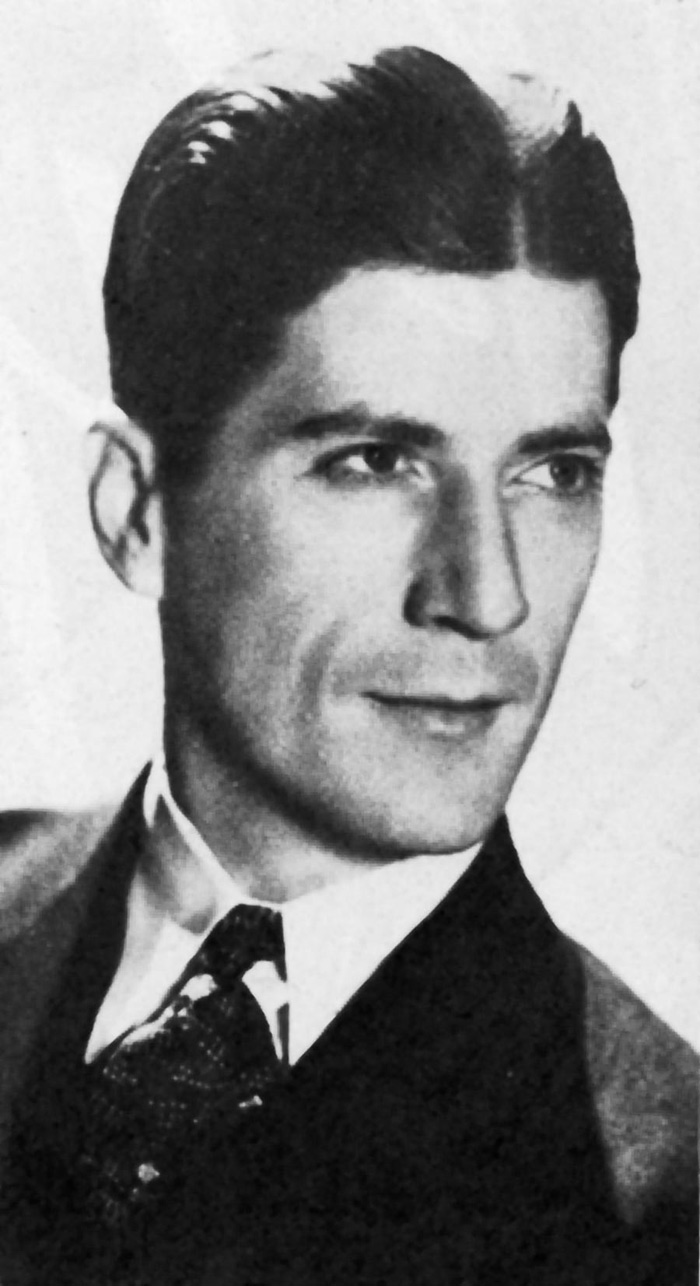
“In 1933, Morrison began the odyssey period of his radio career that took him to 11 different stations in seven different states. He left Fairmont’s WMMN for KDKA in Pittsburgh. He then had brief stints in Milwaukee and Gary, Indiana. In 1935, he took a position in Chicago with WLS, an NBC affiliate that could be heard throughout the Midwest.”
The Hindenburg disaster was the first live news event recorded for posterity and then rebroadcast on radio. WLS Radio Chicago had sent Morrison and engineer Charles Nehlen to New Jersey to cover the airship’s arrival. Nehlen made a sound recording of the event on 16-inch acetate discs. At the same time, Nehlen filmed the zeppelin’s arrival on a hulking camera.
A newsreel of the event, which juxtaposed sound and film, made the disaster famous around the world.
Herbert Morrison grew up on the Pennsylvania side of the West Virginia border and spent much of his life in the Mountain State. His family spent their summers near Morgantown, and he held radio positions in Fairmont and, later, Morgantown. Morrison settled permanently in Morgantown during the 1960s and resided there with his wife for the last three decades of his life, helping West Virginia University develop its media departments while making substantial contributions to the community.
Herbert Oglevee Morrison was born on May 14, 1905, in the small town of Connellsville, Pennsylvania, not far from the West Virginia and Maryland borders. His father Walter died when he was a toddler. His mother, Bertha (Oglevee) Morrison, moved the family to the nearby borough of Scottdale, where she raised Herbert and his older brother, Walter Franklin. Bertha and the boys stayed with Bertha’s mother in a home on Market Street in Scottdale. Several members of the extended Oglevee family lived in the home as well.
The family took in boarders to earn a living. Bertha worked in retail and as a seamstress to support her children. During the 1920s, she worked for a radio station in Scottdale, which Morrison said in later interviews convinced him to give the emerging business a try.
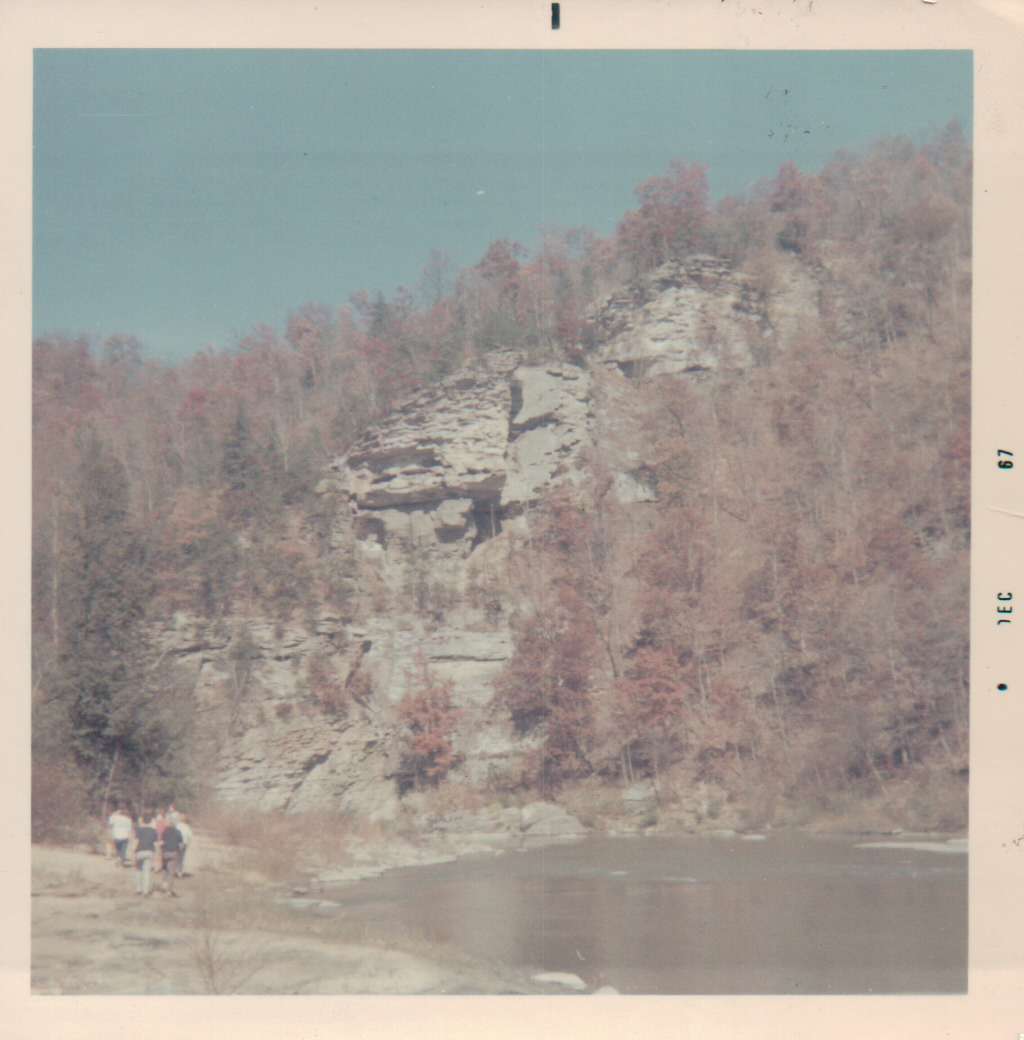
Bertha and her boys visited West Virginia regularly during the 1910s. She took them camping in the Morgantown area near the modern-day Cooper’s Rock State Forest. For the rest of his life, Morrison maintained a foothold in Morgantown.
After graduating from Scottdale High School in 1923, Morrison attended college briefly, earning a commission to West Point but staying only one year. He returned to Scottdale and worked a series of sales jobs while trying to make it as a musician. Morrison learned to play the banjo at an early age and performed in western Pennsylvania and West Virginia. He even depicted a banjo player in the 1924 silent film Classmates, which starred Richard Barthelmess and was filmed around Pittsburgh. At some point during the 1920s, Morrison earned a pilot’s license, which he maintained for the rest of his life.
He broke into the radio business in 1930. At the time, he was working days as a shoe salesman in Fairmont, West Virginia, and went to local radio station WMMN in search of a job. The results were something that only seem possible in the early days of radio.
“It was Friday, June 13, 1930,” Morrison told a reporter from the Tucson Citizen in 1975. “I just walked in, saying I was looking for a job, and they said they needed an announcer. I did some announcing on a record, and the station owner asked some friends how it sounded, and I got the job,” he continued. Morrison boasted a powerful baritone voice which came across well over the airwaves. His background in sales and business proved a further asset to the station. Soon, he became WMMN’s program manager as well as an on-air talent.
During the 1930s, he purchased a home in Morgantown on Cheat Canyon Park Drive, which became his mother’s permanent residence. Bertha lived in Morgantown until her death in 1947.
In 1933, Morrison began the odyssey period of his radio career that took him to 11 different stations in seven different states. He left Fairmont’s WMMN for KDKA in Pittsburgh. He then had brief stints in Milwaukee and Gary, Indiana. In 1935, he took a position in Chicago with WLS, an NBC affiliate that could be heard throughout the Midwest. Initially, he served as an announcer for musical and variety programs. Eventually, he moved into hard news. Morrison’s voice became well known across the region for his coverage of the serious flooding faced in the prairie states during the mid-1930s. Morrison flew an airplane over the flooded regions, assessed the damage, and made on-air reports once he landed.
The reputation Morrison developed from his coverage of the flooding put him in a position to push a pet project. Since joining WLS, he had pestered his employers to allow him to travel to special events to record them for posterity and later broadcast on the air. NBC had a policy against broadcasting recorded events, which reflected industry standards during the early days of radio. This was partially a matter of technological necessity as recording equipment remained quite primitive. It was also a matter of broadcasters trying to provide their audiences with continuously new and novel content. It wasn’t until after World War II that the use of recorded material became commonplace on radio stations.
His bosses at WLS regarded the one-year anniversary of passenger service on the Hindenburg zeppelin airship as a sufficiently important event to test out their new recording equipment. The Zeppelin Company and their American partner, American Airlines, had been pushing media to show up for the event. WLS thought they could use the recording of the landing as a novelty to show off at major events in Chicago in the coming months.
The Hindenburg had been getting a great deal of attention over the previous year. The vessel had made 36 previous passenger trips across the Atlantic. Flights originated in Frankfurt, Germany, and continued on to Rio de Janeiro, Brazil, after a pit stop in New Jersey.
The massive airship was 804 feet long, had a diameter of 137 feet, and weighed 242 tons.
The vessel contained 70 private rooms for passengers, a library, dining room, piano lounge, three bars, and (quite remarkably) a smoking room.
Typically, such vessels used helium as their primary lighter-than-air fuel, but the United States had stopped selling the gas to Nazi Germany in 1936. As a result, the Hindenburg used hydrogen, which was also effective as a lighter-than-air fuel but proved to be a much more unstable and flammable commodity.
The Hindenburg was supposed to arrive in Lakehurst in the early afternoon, but persistent rainstorms delayed the landing. Eventually, the airship headed for the terminal with plans to land at 7:25 PM. Nehlen started recording at approximately 7:15 as Morrison set the scene. A light rain started as the zeppelin began its descent.
It took just 34 seconds for the Hindenburg to burn up completely.
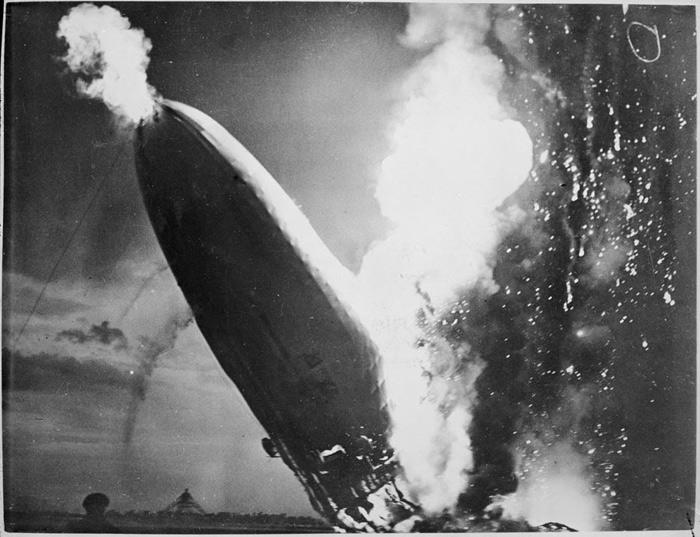
“Get out of the way, please! It’s burning, bursting into flames, and the… and it’s falling on the mooring mast and all the folks between it. This is terrible; this is one of the worst catastrophes in the world. Crashing, oh! Four- or five-hundred feet into the sky and it… It’s a terrific crash, ladies and gentlemen. It’s smoke, and it’s flames now, and the frame is crashing to the ground, not quite to the mooring mast. Oh, the humanity, all the passengers. I don’t believe it,” Morrison said as the tragedy unfolded. Morrison’s coverage proved a model of broadcasting professionalism. He set the scene, described the terrible events as they unfolded, and expressed empathy and emotion in response to the disaster. Nehlen, too, shows a remarkably steady hand as a camera operator, considering the events unfolding around him.
Morrison and Nehlen dropped their equipment and ran toward the fire, helping members of the crew pull survivors to safety. The exact cause of the fire remains a matter of dispute.
After saving several lives, Morrison and Nehlen continued reporting on the event and interviewing survivors of the disaster.
Nazi officials on the scene tried to impound the recording equipment at the Lakehurst terminal. Instead, Morrison and Nehlen absconded to safety, boarding a flight in nearby Newark, New Jersey, and heading home to Chicago that night. By noon the next day, Morrison’s “Oh, the Humanity” response to the disaster was broadcast from coast to coast on NBC’s radio network. This was the first time in radio history that a recording of a news event was broadcast on the air. It was also the first coast-to-coast broadcast of such an event.
Morrison’s descriptions of the crash were then dubbed onto the footage his partner Nehlen had shot that day. The newsreel of the Hindenburg disaster became one of the most recognizable in the history of motion pictures.
Morrison’s voice sounds nasal and high-pitched in the recording, which contrasted with his typical radio broadcasting baritone. In published interviews, Morrison never addressed this aspect of the story, but several media historians have theorized that the primitive acetate recording equipment sped up the sound recording, making Morrison sound a bit like the Chipmunks.
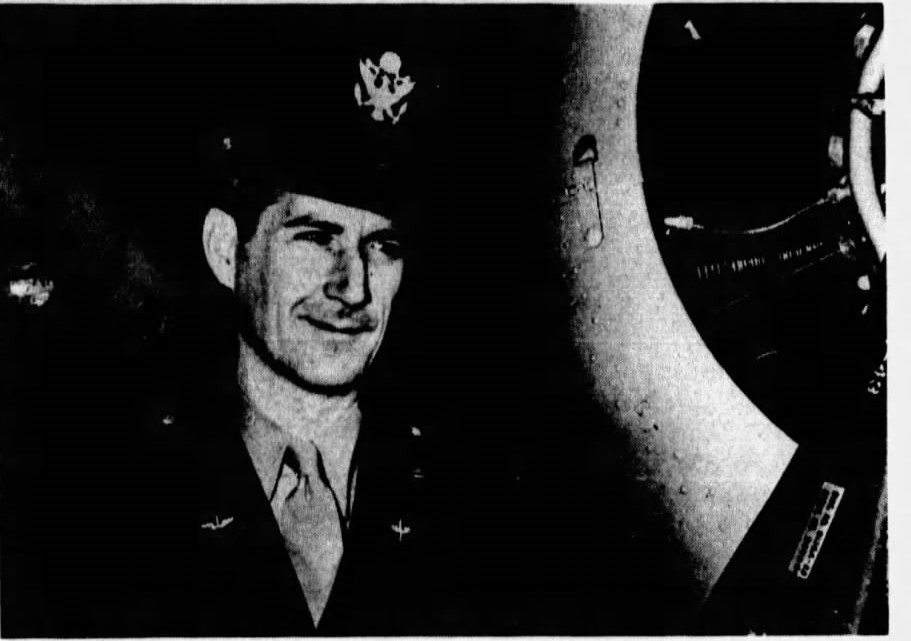
Morrison left WLS in the late 1930s and returned to Morgantown. He enlisted in the US Army soon after America’s entry into World War II. Morrison served in the Army Air Corps, attaining the rank of captain. He spent much of the war at Tinker Field (now Tinker Air Force Base) in Oklahoma City, training new pilots and supervising post operations.
After the war, Morrison worked as a reporter on WTAE radio in Pittsburgh before becoming the first news director at WTAE-TV in Pittsburgh, the Steel City’s ABC affiliate.
In 1948, he married Mary Jane Kelly of Scottdale, a longtime acquaintance who had worked for years at a bank. At the time, Mary Jane was 36 years old, and Herbert was 43. The couple never had children.
Morrison was a lifelong Republican who ran unsuccessfully for Congress on three occasions during the 1950s in a heavily Democratic western Pennsylvania district. In 1963, Morrison retired from WTAE and moved permanently to the home in Morgantown he bought three decades earlier for his mother.
In 1967, Morrison took a position at West Virginia University (WVU). His assignment was to develop a radio and television division at the state’s flagship university. Morrison worked under the auspices of the University Relations department and created audio and visual content for the institution. In addition, He founded the university’s educational television network and the university’s internal news service.
Morrison’s presence proved to be an asset for WVU fundraising as well. On several occasions during the 1970s, he served as the keynote speaker for on-campus Alumni and Homecoming events. Morrison spoke about his local roots as well as the events of May 6, 1937.
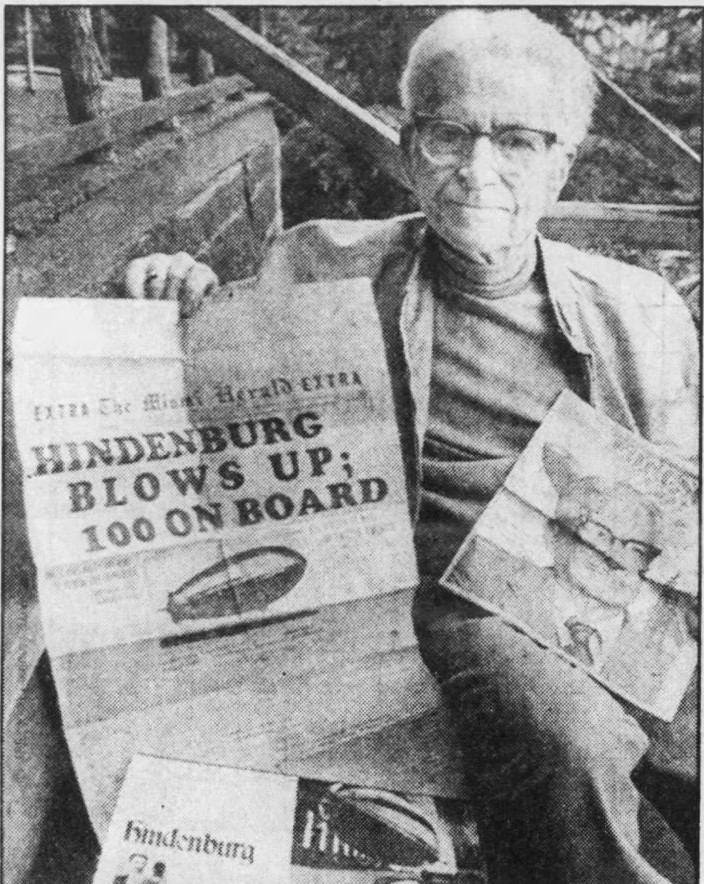
Michael Mooney’s 1972 book on the Hindenburg disaster and the subsequent 1975 film, The Hindenburg, starring George C. Scott and Anne Bancroft, brought Morrison back to public attention. Morrison worked as a technical consultant for the Robert Wise-directed film. Television and newspaper reporters from across the country came to his Morgantown home to ask him about that fateful day in New Jersey. There are numerous images of Morrison from that era, holding up newspaper accounts of the Hindenburg disaster.
When they weren’t tending their garden or going for a flight on Herbert’s private plane, the Morrisons spent considerable time serving their community. They volunteered at University Hospital in Morgantown (now known as the J.W. Ruby Memorial Hospital) regularly throughout the 1970s.
During the 1980s, Herbert suffered from a series of illnesses. In September 1988, Morrison moved into Morgantown’s Sundale Nursing Home. He died there on January 10, 1989. He was buried in Scottdale. Mary Jane died 11 years later and was buried next to him.
Little remains in the way of physical reminders of Morrison in Morgantown. The most tangible testaments to his life can be found in the thriving local institutions to which he contributed during his lifetime.

Clayton Trutor
Trutor, Clayton. ““Oh, the Humanity!”: Longtime West Virginia Resident Herbert Morrison was the Voice of the Hindenburg Crash.” Goldenseal West Virginia Traditional Life, Spring 2026. https://goldenseal.wvculture.org/oh-the-humanity-longtime-west-virginia-resident-herbert-morrison-was-the-voice-of-the-hindenburg-crash/