


By John A. Hunter
It was over 65 years ago when my father took my younger brother, Harry, and I, along with our good friends Ricky and Johnny Whitehair, on the long hike up to Boone’s Rock. Boone’s Rock is a large boulder that sits on a ridge behind the “Hospital Bottom” where we lived in Madison. The rock was named in honor of Daniel Boone, who explored the area and for whom the county is named. Like other ridge outcroppings in southern West Virginia, Boone’s Rock is primarily composed of quartz-rich sandstone dating back to the Pennsylvanian geologic era.
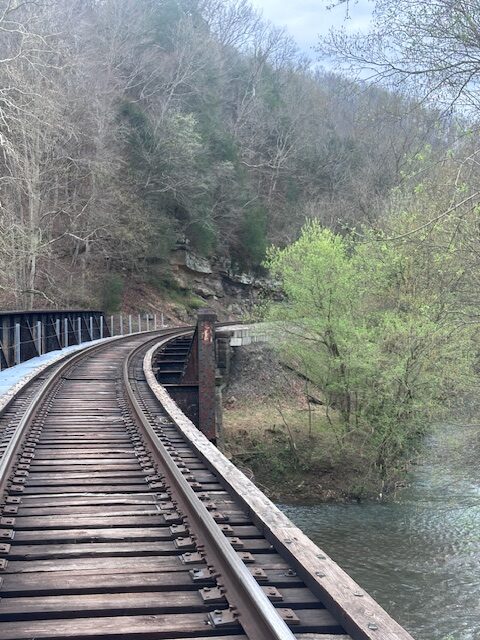
To get to the trailhead, we had to walk across the railroad trestle traversing the forks where the Spruce and Pond Fork rivers merge to form the Little Coal. One of the things that got drilled into your head as a kid was that you should never get caught on the trestle when a train was coming. As anyone who grew up in southern West Virginia in the 1950’s and 60’s can attest, coal trains came down the tracks pretty darn frequently back then, so it always seemed that the margin for error was pretty thin.
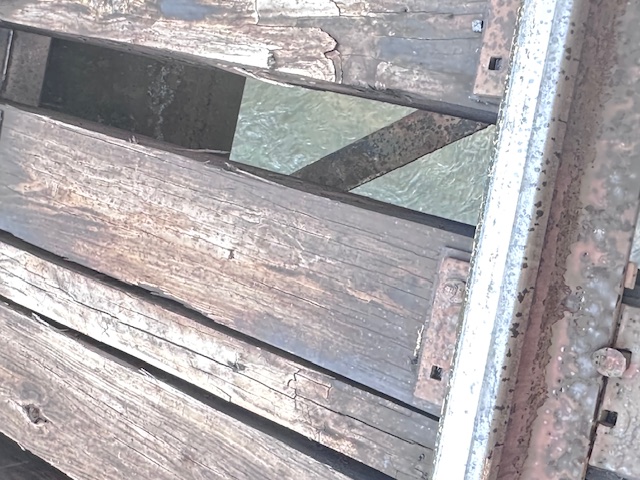
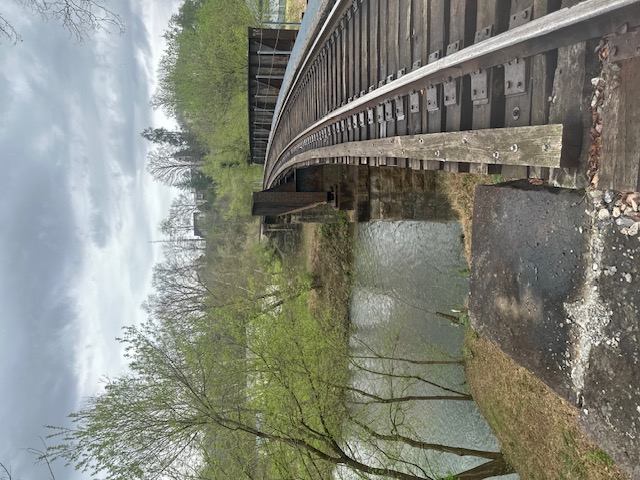
I remember my father picking up and carrying my brother and “Little John” Whitehair across the trestle so they wouldn’t get scared. He deemed Ricky and I old enough to manage this feat on our own, but suggested that we refrain from looking down between the spaced railroad ties to the swirling river some 30 feet below. His pronouncement of our fitness for independent crossing gave me no shortage of budding masculine pride—that is, until Ricky and I got about halfway across the span and succumbed to the apparently irresistible urge to look down on the dark, rapidly flowing river in the depths below. I think it was something akin to the scene in Mel Brooke’s film “High Anxiety” where you are free-falling into a spinning vortex, for it was upon that sight that my previously impenetrable self-confidence abandoned me about as quickly as it takes my yellow lab, Luke, to get to his food bowl each morning. Let’s just say for purposes of historical accuracy, that Ricky and I required parental escort for the second half of the trudge across the trestle.
Once we were able to plant our feet on solid ground again, and breathe a huge sigh of relief, the long climb ensued. On the way up, our father instructed us in the names of the various tree species we were passing and pointed out that no matter how thirsty we might be we should never drink water from the small streams running down the mountainside, for they could be contaminated and carry disease. I remember him saying that in a state of dire thirst you should follow the stream up to where it first emerged from the ground, and while still with some risk, it would be the safest place to fetch a cool drink.
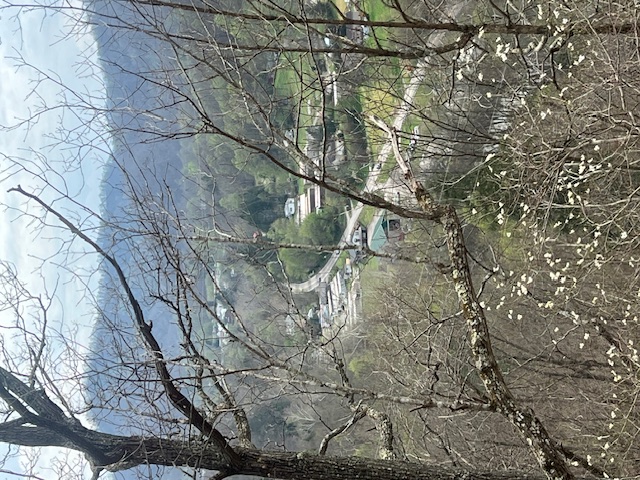
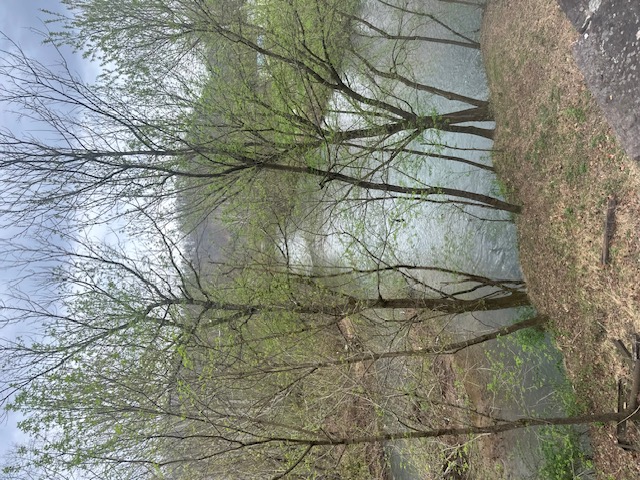
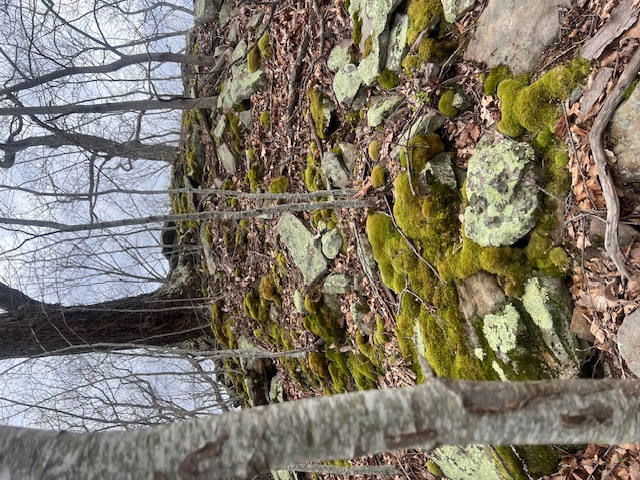
After what seemed an interminable climb up the steep mountainside, we finally reached the top of the ridge and there majestically stood before us, Boone’s Rock. As a young child, it looked enormous and rather formidable. A great, gray monolith with various concave crevasses on its rugged face. I was rather anxious when I hiked up the back side of the rock and cautiously climbed up to where you could walk out on its upper ledge. What I remember most poignantly is how I could see all the way down to the Hospital Bottom far below. Our house, and the neighbors walking about, seemed minuscule from such a high perch. I saw my sister walking between our house and my aunt’s next door and chuckled to the thought that she would never understand how I could possibly know what she did that afternoon while I was so far away in the mountains. In many respects, it felt like I was sitting on the top of the world looking down on all of God’s creation. In fact, it was pretty much the entire world that I knew back then, and there was a sweet simplicity and innocence to it. The world, it seemed, was composed of endless mountains with large rocks that were there to be climbed and explored by boys like me.
The view from the top of Boone’s Rock has been etched in my mind all of these years. I am 74 now and long past my boyhood. I no longer live in the mountains of West Virginia, but now reside far away, below sea level, in the marsh-like land of New Orleans. However, there was something about that childhood hike that was transformative, and I have yearned to make the climb again. It’s as though Boone’s Rock has been calling my name and beckoning me to revisit it. With the thought that perhaps there is more to be learned, that the story has not been fully told, I decided to answer the call.
My father passed over a decade ago after living to the ripe old age of 92. My brother lives in Virginia Beach and because of health issues could not make the climb again. However, he helped me recollect the details of the original hike and has been with me in spirit throughout this quest. I have not seen the Whitehair brothers since childhood, as their family moved from Madison to Morgantown many years ago. So, given present circumstances, I decided to call on my lifelong friend, Bill White, who still lives in Madison. Bill and I have been on many an adventure together, both as children and adults, so I knew I could count on him. As predicted, he readily agreed to take on the challenge of hiking with me up to Boone’s Rock.
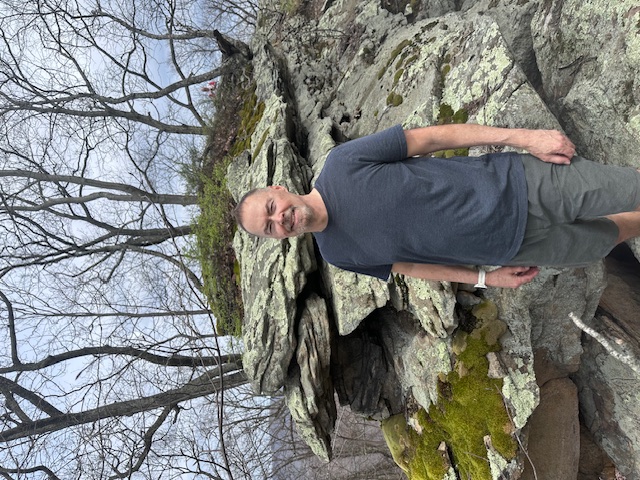
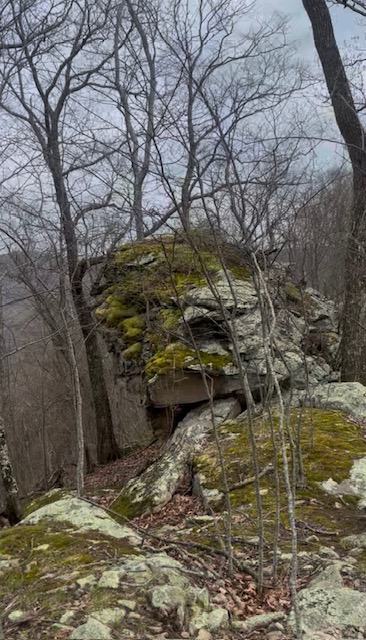
By the time I arrived in West Virginia in early April for the return trip, our climbing party had grown to include Ron Stollings, a local internal medicine doctor and former West Virginia state senator. Ron is an avid hiker and outdoorsman who knows the trails of Boone County as well as anyone. However, he had never made the hike to Boone’s Rock and was eager to accompany us. I arrived on a Thursday evening and the plan was to hike on Saturday morning. Quite honestly, I began to have some serious doubts about the viability of the climb when I studied a topographical map Friday morning. The map showed that if you went straight up the mountainside from the river forks it was an elevation gain of 700 feet over the course of about two-thirds of a mile. That made for a nearly 20 percent steepness grade. The consulted online hiking guide used words like “strenuous”, “challenging”, and “difficult”, and likely to result in a “high heart rate” for those not in excellent physical condition. It added the warning that the climb would be even more difficult if there was loose rock and soil, something there was an abundance of. When I asked “AI” how it compared to running two miles in New Orleans, it basically said there was no comparison—the hike would be far more exacting and demanding.
With that unsettling information lurking in my brain, I nervously decided to do some reconnaissance work with Bill later that morning. It began with a repeat of the trek across the railroad trestle. I would like to tell you that the return crossing as an older adult was in stark contrast to the near trauma it had caused as a young child but that would be a bit of an overstatement. In truth, once again gazing down through the railroad ties to the rapidly flowing river far below instantly produced a visceral recollection of why I didn’t enjoy the walk so many years before. It didn’t help that Bill decided about half way across to tell the story of how a childhood friend of ours once panicked and tried to climb off the trestle when he heard a train coming down the tracks. While we didn’t hear any train whistles this time, or try to climb off the trestle, I found myself in no mood to loiter and was pleasantly relieved when I finally reached the other side.
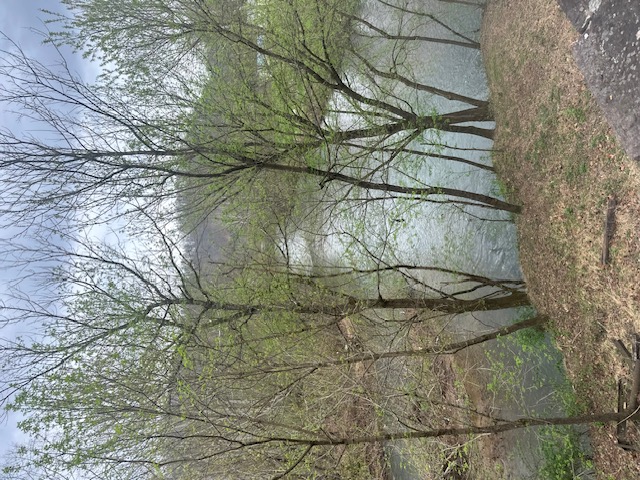
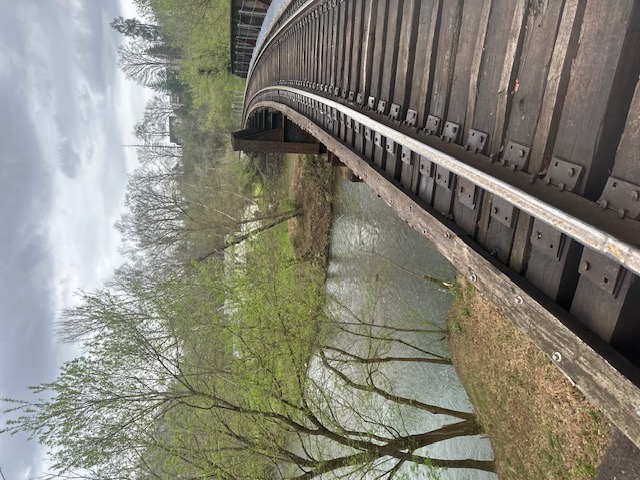
Bill and I then proceeded to examine the options for beginning the climb to Boone’s Rock. Essentially, there appeared to be two. We could either scale the very steep entrance to the mountain immediately above the forks or walk down the tracks about a quarter of a mile to where there was a slightly gentler incline. We decided to explore the latter and ended up walking up the lower part of a vertical ridge to an elevation gain of about 200 feet before it began to rain. We retreated at that point and walked back down, only to receive a text from Ron saying that he wanted to meet us at the post office and show us another potential route up the mountain via Miller Hill. Upon our arrival, Ron came roaring into the parking lot on a yellow 4-wheeler and with a big grin told us to hop in. He then drove us to the backside of the mountain where there was a narrow dirt and grassy track leading up the hillside. After what felt like a ride on the old Camden Park roller coaster, he jumped out and pointed to what he thought was the lower edge of the main horizontal ridge leading up the mountain. Without initially intending to do so, we soon were on a mission to get to the top of the ridge to see if it indeed would lead us to Boone’s Rock.
It was quite the climb for there was no trail other than where you could see that deer had made their way up the mountainside. Bill, the consummate hunter, commented on the many hickory and chestnut oak nuts along the way and pointed out where deer had rubbed the bark off trees with their antlers during rutting season. The farther we went, the steeper the climb became and eventually there were several sections where it was a scramble and you had to grab onto tree saplings and rocks to pull yourself up and prevent falling and sliding down the hillside.
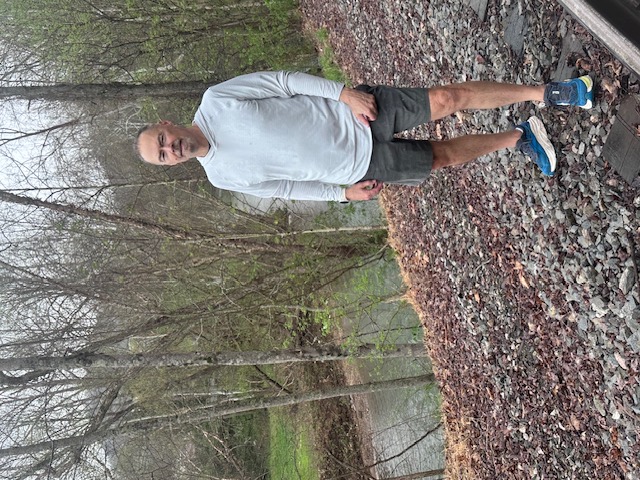
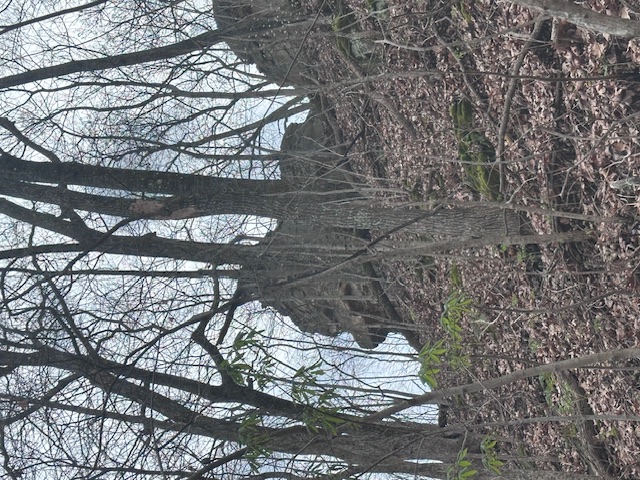
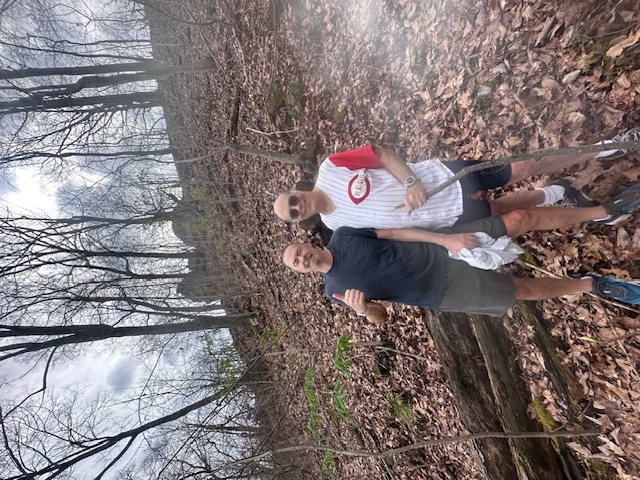
With Ron enthusiastically leading the expedition, I breathlessly followed behind contemplating how living in New Orleans so many years had deprived me of the mountaineering skill and endurance of my youth. Furthermore, I silently lamented that you can’t adequately train for climbing mountains in West Virginia by running in the flat city parks of New Orleans. Nonetheless, I trudged onward with the hope that we were eventually going to make it to the top, and to my great relief and joy we ultimately did. There patiently waiting for me was my old friend, Boone’s Rock, looking old and craggily but still standing tall and proudly lording over the valleys below. The view from up there was perhaps even more spectacular than what I had remembered. The vista was stunning. You could literally see for miles. It once again felt like I was sitting on top of the world looking down on all of God’s creation.
The trip down the mountain was only slightly easier than the trip up. While a bit less winded, I could sense my legs growing weaker and more fatigued with every step. It took considerable concentration and caution to prevent falling and seriously injuring myself. I was quite tired but very happy when we finally reached the point down the mountain where the 4-wheeler was parked. The mission had been accomplished. We had made it to the top of the ridge and to Boone’s Rock. I had seen it and touched it again.
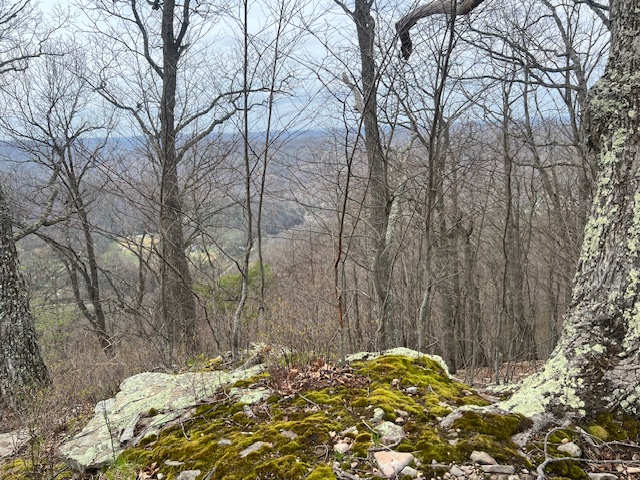
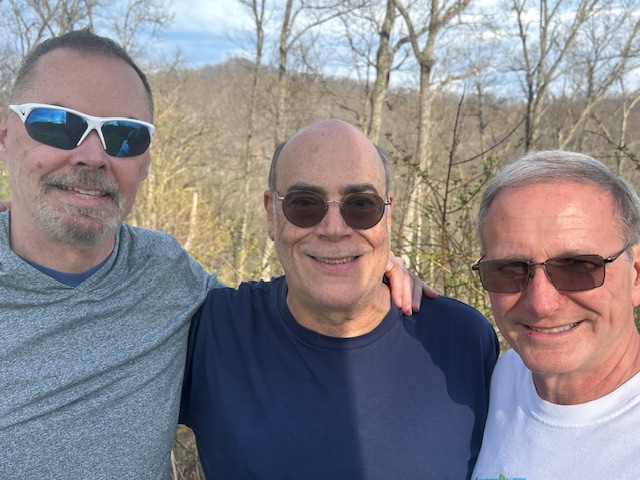
I have thought a lot about the call of Boone’s Rock and what the climb was all about. Upon reflection, I believe that it was far more of a spiritual journey than a physical test of whether I could make such a climb at my age. It had brought me back to where I was born and reconnected me with both the land and the people I grew up with. West Virginia is in my DNA; my family has lived in its wondrous mountains for centuries. Growing up there has shaped the way I see the world and is an integral part of who I am as a person today. As anyone who grew up in West Virginia but later moved away knows, it will always be the place you call home. You feel it immediately upon arrival. You know that you are back from whence you came and amongst the people who know you the best and care about you the most.
I am very grateful to Bill and Ron for accompanying me on the journey. I could not have done it without them. I am grateful for having had the opportunity to come back and experience it once again. And finally, and after considerable pondering, I think I pretty much had it correctly philosophically reasoned as a child—the world is composed of endless mountains and large rocks that are there to be climbed and explored by boys like Bill, Ron, and me.


John A. Hunter
Hunter, John A. "Return to Boone’s Rock." Goldenseal West Virginia Traditional Life, Summer 2026. https://goldenseal.wvculture.org/return-to-boones-rock/