By Robert Rupp
The 1960 West Virginia primary demonstrated John F. Kennedy’s use and mastery of the newest medium in American politics—television. His most historic use of that medium occurred on May 4,1960 when he debated Senator Hubert Humphrey on live television. Broadcast from WCHS studio in Charleston, the event was carried on four other television stations in the state: WHIS in Bluefield, WBOY in Clarksburg, WTRF in Wheeling, and WTAP in Parkersburg.
Americans in selected cities outside the state watched the event on the Westinghouse television network, which had outlets in San Francisco, Boston, Washington, Cleveland, and Pittsburgh.
That night Kennedy successfully displayed an aptitude at communication in the new medium. He focused on state issues, spoke in plain language, and even employed a visual aid when he held up a can of surplus government food as he discussed the need for better nutrition. His performance foreshadowed his success in debating Richard Nixon in the fall, and in using television in his administration.
Even so, Kennedy’s participation in the televised debate with Humphrey represented his most risky use of the new medium. For a live debate contained elements of uncertainty that were not present in his scripted ads or his mock interviews featuring a friendly host asking him questions that he knew in advance.
“The debate represented one more signpost in the ascension of television as the dominant media, but few recognized the historic importance of the broadcast at the time.”
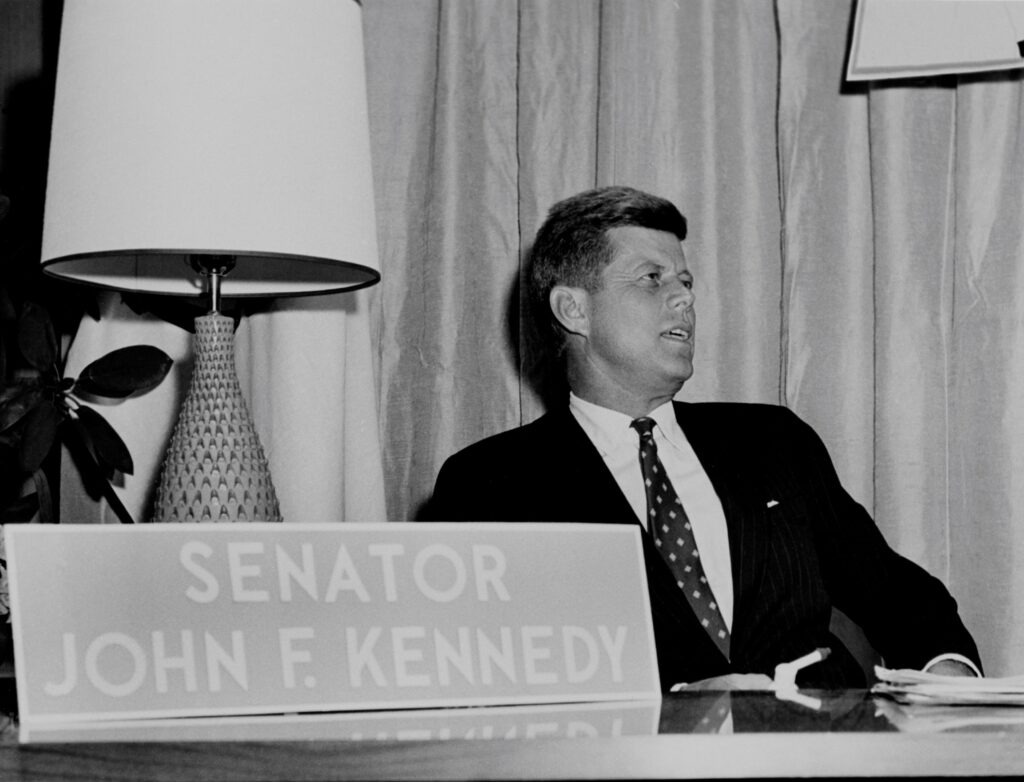
Such risks prompted Kennedy to refuse to engage in a debate in the Wisconsin presidential, let alone a televised debate. His refusal also reflected conventional wisdom that any debate always helped a challenger and could hurt the frontrunner.
Whatever the reason for the senator’s new stance on debates, the stage was set for history. Only once before in American presidential politics had there been a televised debate between two presidential contenders. In 1956, during the Florida presidential primary, ABC televised a debate between contenders for the Democratic nomination, Adlai Stevenson and Estes Kefauver. But the format was more a discussion than a debate. The event had no opening statements and involved only a couple of questions for the candidates.
Now in Charleston, West Virginia, on May 4, 1960, there would be a second event reflecting the more traditional debate format that would be used in most of the succeeding presidential campaigns.
The televised debate in West Virginia was a collaboration in voter education between the state’s leading newspaper and the capital’s newest, largest, and most popular television station, WCHS-TV. W. E. (Ned) Chilton III, assistant to the publisher of the Charleston Gazette, and John T. Gelder Jr., general manager of WCHS-TV in Charleston, came up with the idea.
Although the debate marked a symbolic milestone in the use of American television, the printed press dominated its implementation. Gazette promotion manager James E. Dent contacted the campaign managers and arranged the format, and Gazette readers submitted questions.
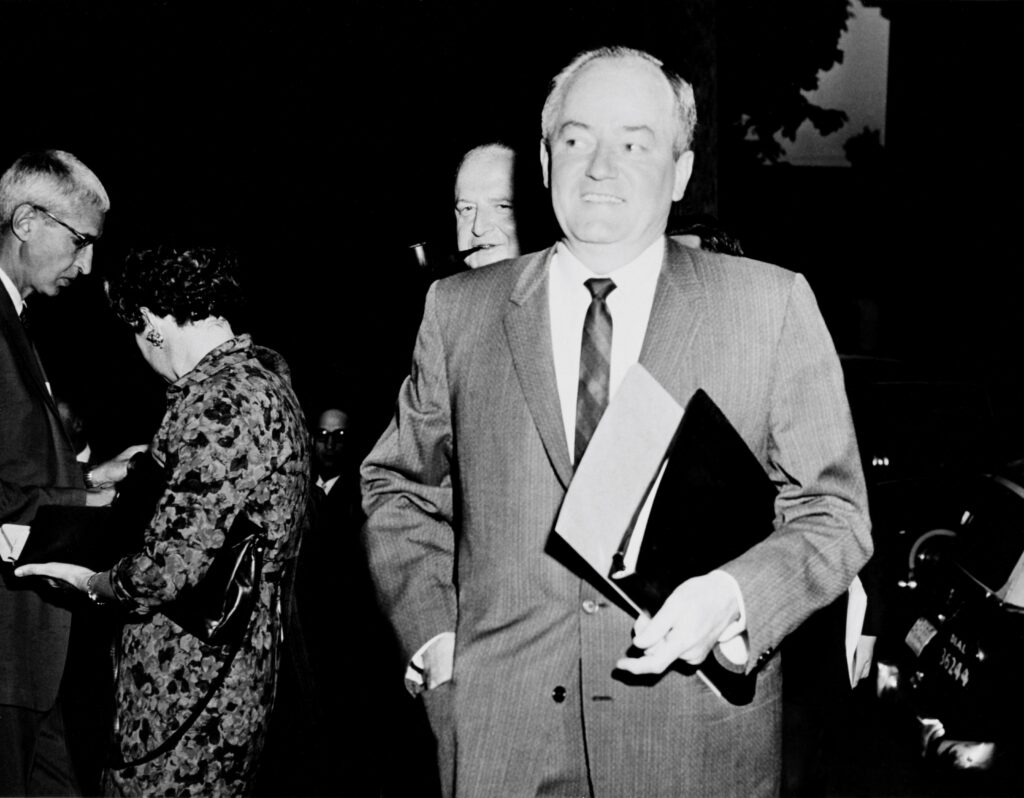
The Gazette encouraged reader participation by running ads in the paper with a coupon that readers could complete and return. The ads read,
“PRESIDENTIAL PRIMARY DEBATE QUESTIONS: Do you have a question you’d like to ask Sen. Hubert Humphrey or Sen. John F. Kennedy in their WCHS television debate May 4? If so, fill in this coupon.”
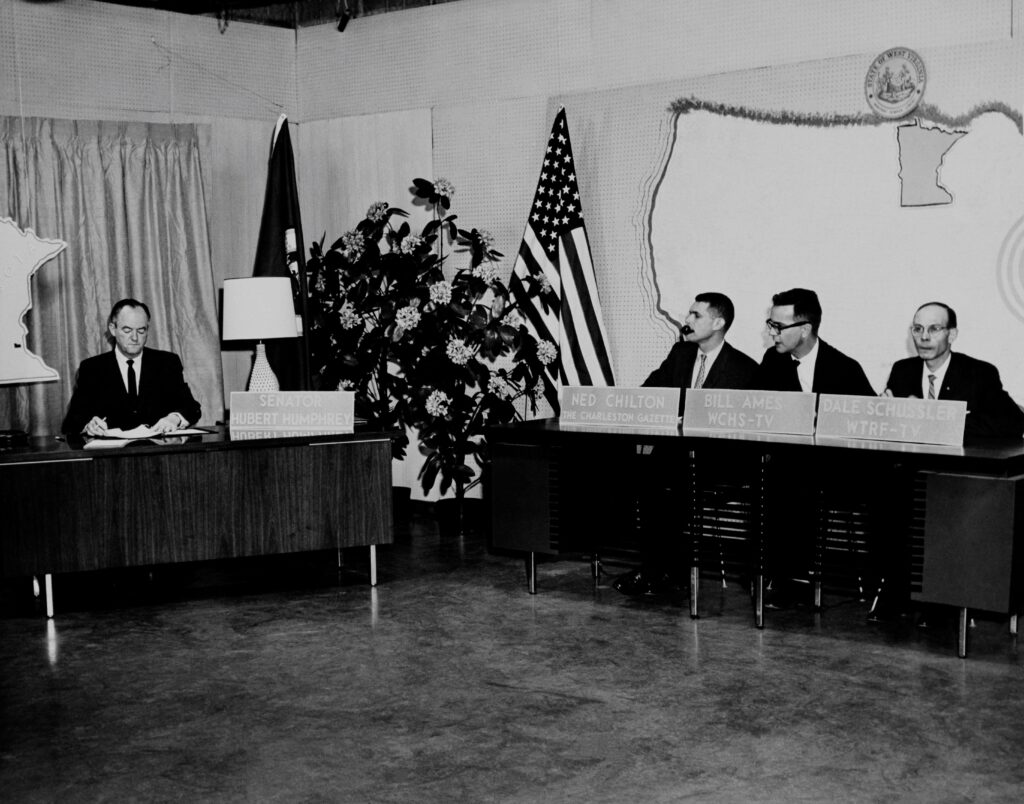
Besides the two candidates, there were three journalists in the studio that night, but their roles were limited. Bill Ames, news director of WCHS-TV, served as the moderator, and the two-member panel asking selected questions consisted of Ned Chilton and Charles Schussler, a television reporter for WTRF-TV in Wheeling.
The debate represented one more signpost in the ascension of television as the dominant media, but few recognized the historic importance of the broadcast at the time. Schussler later recalled that his station sent him only because no one else on the staff wanted the assignment and the long drive to Charleston that went with it.
But television came out the champion, as the medium was able to transmit the event instantly to more than a half million persons. Even the Gazette acknowledged its advantages. An editorial noted, “Television has a responsible role to play in the political campaigns, for no other medium can attract so vast an audience or have so immediate impact.”
The primitive status of the new medium was evident in the studio set. Because the cameras didn’t have a zoom lens, the identification cards for the reporters and the candidates were printed in very large type. The only graphics were drawings of Minnesota and Massachusetts.

“The lack of conflict also reflected the ideological similarity of both candidates in the 1960 Democratic primary. They both favored an active federal government in principle and promised to take such a role in the Mountain State.”

On the night of the debate, John Kennedy arrived at the WCHS studio just minutes before the event started at 7:30 p.m. The television station was in a converted downtown mansion on Kanawha Boulevard. Kennedy won a coin toss by moderator Bill Ames and chose to give his opening statement second. It was the first of many wise choices the Massachusetts senator made that night. The debate, while not that substantive or heated, proved to be a success for Kennedy in terms of style. The man who would have the first “televised presidency” demonstrated his skill in that medium.
While Humphrey led off with a statement more suited for a national audience, Kennedy made no such mistake. His priority was West Virginia voters. The candidate who entered the West Virginia primary as an outsider used the televised debate to help transform himself into an articulate and effective promoter of the Appalachian state that would impact his political future.
His performance surprised New York Times reporter James Reston, who noted that it was usually Senator Humphrey who made a connection with the audience. At the Charleston debate, however, it was Kennedy “who concentrated on the specific illustrations, and who avoided the jargon of Washington for the simple language of the average voter.”
For an Appalachian audience, Kennedy sounded all the right themes, starting with praise. In his opening statement, Kennedy offered admiration for the courage of West Virginians, singling out not just those who worked in the mines, but also those who served their country. He personalized the latter by remarking, “I was in Hinton this morning, which is the home of the navigator who flew with my brother before he was killed.”
When he talked about the large number of West Virginians who lived on surplus commodities (250,000), he personalized the statistic by reading a letter sent to him by McDowell County resident A. F. Johnston, who wrote about what he received every month from the government: “I’m a man with TB and I have to get surplus food. I have seven children. This is what I receive, 5 bags of flour, 4 cans of eggs, 3 5-pound bags of meal, 8 pounds of shortening, 4 pounds of rice, which you can’t use if you don’t get it clean, and 4 of milk. We do not get any butter, cheese, or beans.”
Then in a dramatic visual statement, Kennedy pulled out a can of powdered eggs hidden behind his nameplate. “These are the powdered eggs. For a family of four, you get three of these for a month. . . 250,000 people in West Virginia are getting this kind of assistance every month……. It is an inadequate diet.”
The videotape and transcript of the debate itself confirm the assessment of the contemporary press that, like most campaign debates, it was a dull affair. “The most exceptional thing about the debate, was the lack of debate,” reported Tom Stafford, who said that “Hubert Humphrey and John F. Kennedy threw away their brass knuckles here Wednesday night when they faced each other on TV camera, and discussed the nation’s gravest issues with senatorial dignity.”
Indicative of the lack of fireworks, little time was spent on the most controversial issue in the West Virginia primary: Kennedy’s religion. That issue was raised early in only two questions and quickly dispatched during the rest of the hour-long debate.
What the public didn’t know was that managers from both campaigns had cautioned the candidates against personal attacks. Humphrey’s Herb Waters and Kennedy’s Larry O’Brien had met to figure out how to “keep our two tigers from tearing each other apart.”
The men successfully convinced the candidates to agree to not attack each other. According to Waters, “Both principals agreed to this, but it was a tense moment when they came face to face because each didn’t know if the other was going to break the rules.”
The lack of conflict also reflected the ideological similarity of both candidates in the 1960 Democratic primary. They both favored an active federal government in principle and promised to take such a role in the Mountain State. So both participants spent more time attacking Republicans than each other.
The complaints about the tameness of such confrontations ignore the real value of such an event. As the Morgantown Post observed, “That night the newsmen wanted blood and grime—and they were disappointed. But the people wanted to see what the candidates looked like.”
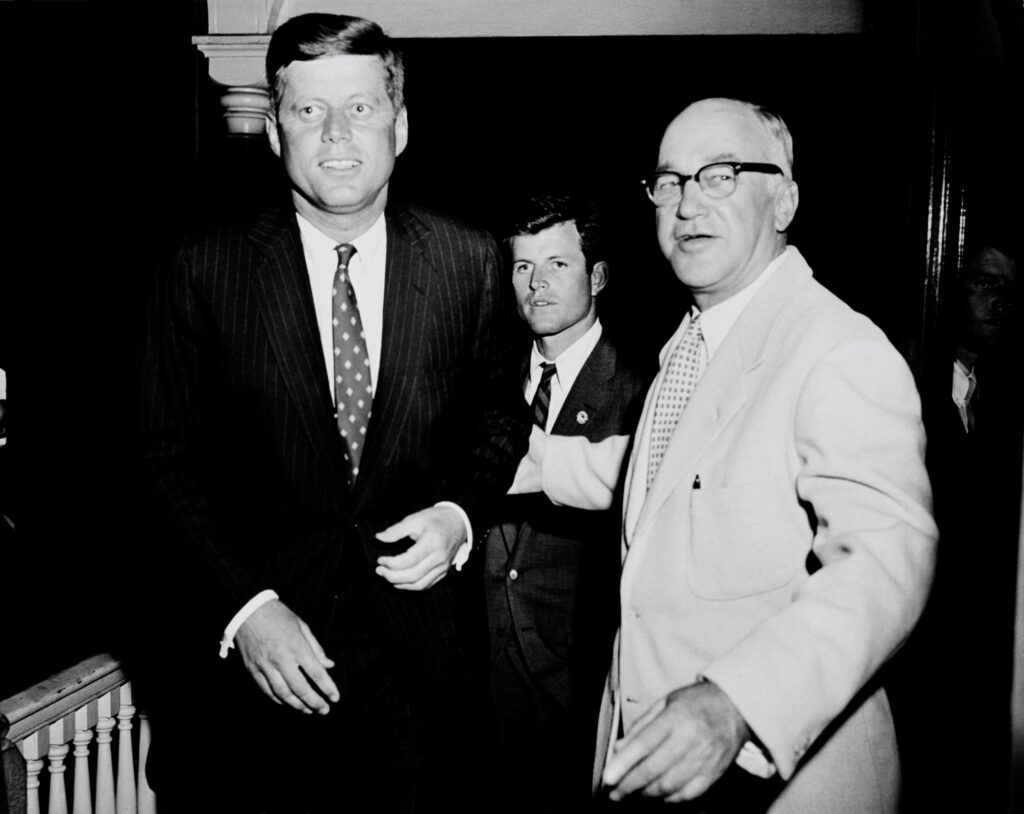
The Kennedy-Humphrey debate was more important to history in general than for its impact on the outcome of that state’s presidential primary. While the event wasn’t what the press anticipated or wanted, James Reston of the New York Times understood that its importance lay in what it “set for the future, not the fireworks it did not display.” The most significant outcome, he argued, was that the winner was “not the man but technique of using modern communication.”
West Virginia had an impact on the famous 1960 Kennedy-Nixon debates later that year. Both Kennedy and Humphrey believed that its success contributed to the national networks’ decision to initiate the Kennedy-Nixon debates in September. Kennedy’s strong performance exceeded expectations, and his success may have made him more willing to engage Nixon, who was considered, like Humphrey, to be a strong debater. Ironically, the reverse could also be true. Nixon, who watched a tape of the Charleston debate, may have considered Kennedy a weak debater, and therefore have been more open to participation in the fall debates.
In an earlier TV Guide article Kennedy had predicted that the medium would alter the relationship between candidate and voter. The West Virginia televised debate in the spring of 1960 dramatically demonstrated his effective use of the new medium in American politics.
DR. ROBERT RUPP
Educated at Ohio Wesleyan University and Syracuse University, Dr. Robert Rupp taught at West Virginia Wesleyan College for 30 years. During that time he contributed regularly as a regionally known and recognized political analyst to newspapers and public radio. In his final years of teaching, he published, The Primary That Made a President: John F. Kennedy and West Virginia. Throughout his career, he held numerous public service positions, such as being a member and chair of the West Virginia State Election Commission and serving on the Upshur County School Board.
Rupp, Robert. “Role of the New Medium: The West Virginia Televised Debate of 1960.” Goldenseal West Virginia Traditional Life, Fall 2025. https://goldenseal.wvculture.org/role-of-the-new-medium-the-west-virginia-televised-debate-of-1960/