By M. Raymond Alvarez
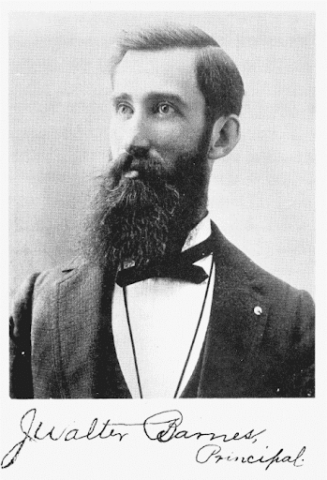
In 1923, James Morton Callahan, a professor of history at West Virginia University, described Fairmont’s J. Walter Barnes as “a prominent figure in the educational, business and public affairs of West Virginia” in his book The History of West Virginia, Old and New. Callahan noted Barnes’ “gifted personality, unusual resourcefulness, sound judgment and executive power and undeniable public spirit.” Barnes contributions to the community, the region, and state made him one of the significant historical leaders in expansion of education and industry in North Central West Virginia.
Born in Marion County in 1862, James Walter Barnes completed two years of teacher training at the Normal School in Fairmont in 1881. After a short period of teaching, he studied law in the office of Ulysses Near Arnett, Jr. He finished his studies in law in 1883 and opened an office in Fairmont. He married Olive Cooper of Clarksburg in 1884, and the couple eventually had five children. In 1885, he was asked to join the faculty at the Normal, where he taught history, language and mathematics until he was named principal in 1892, continuing in this role for nine more years.
Fairmont Normal School, forerunner of today’s Fairmont State University, was designated as a branch of Marshall College in 1868 by the WV Legislature. Both a graded public school as well as the Normal School were housed in the same building at the top of Adams and Quincy Streets in Fairmont for 24 years.
By the late 1890s, under Barnes’ leadership, the Normal’s enrollment had grown and prospered as a source for training well qualified schoolteachers for the state. A larger, separate building was needed to house them. He led the movement to secure adequate appropriations from the Legislature to relocate the Normal school to its own campus on a spacious lot in the South Side of Fairmont. The Masons set the cornerstone in June 1892. The new campus opened on March 27, 1893, in the 200 block of Fairmont Avenue.
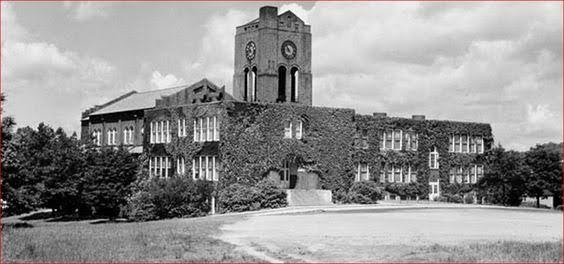
Constructed of red brick with stone lintels and sills, the three-story building was described as “imposing and grand.” The Normal had gymnasiums, 11 large classrooms, a science apparatus room, a chapel, study hall, music room, lyceum hall and a library. The third story held a large auditorium capable of seating 1000 persons. The Fairmont Free Press reported that the building was considered the ‘most complete and commodious of any single building’ in the state.
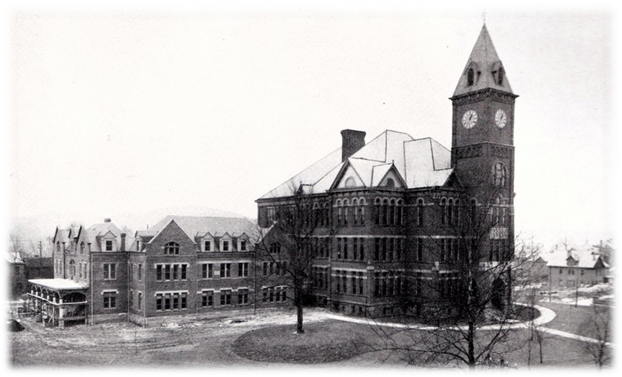
By the end of the century, Barnes wanted a structural change to the original Italianate ornamental tower to a more Edwardian looking clock tower. Students were habitually late for mandatory chapel at 9 a.m. and this was his solution to getting them assembled on time. He secured subscriptions of $250 from the students and considerable contributions from Fairmont businessmen so that the original campanile and balcony could be removed and replaced with brickwork to support a four-sided clock and large bell. Designed by Fairmont architect Andrew Lyons [see Fairmont Architect Andrew C. Lyons by Raymond Alvarez in our Fall 2014 issue ], a higher, steepled roof and weathervane crowned the new structure.
Dedicated in 1899, the 1600-pound bell was engraved with Barnes’ name and also the WV Board of Regents (Waitman Barbe, Robert Stuart Carr; Harvey Harmer; J. Russell Trotter and George W. Johnson). Soon it became one of Fairmont’s landmarks. The bell’s peals could be heard on both sides of the river and along Fairmont Avenue, now lined with lavish new homes and mansions of the region’s coal barons as the city expanded its South Side.
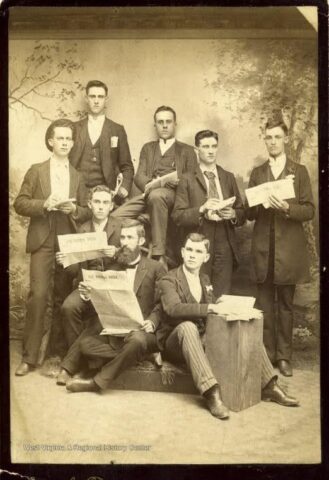
“Barnes initiated student journalism in 1896 and began working on new ways to expand teaching training under supervision at local schools. He continued to guide expansion of the curriculum in a progressive era.”
With the clock tower completed, Barnes chose to end his academic career and use his skills in another field needed for economic development—expansion of telephone service. In 1901, separately chartered telephone companies in Fairmont, Mannington, Grafton and Clarksburg joined to create the Consolidated Telephone Company with Barnes serving as General Manager. The Fairmont Times reported in January 1904 that “the offices of General Manager J. Walter Barnes of the Consolidated Telephone Company has been moved from the Hutchinson Building to the front room of the third floor of the People’s Bank Building on Main Street. Here Mr. Barnes has a commodious office and it will be elegantly fitted up.”
His leadership and acumen in negotiating business was now recognized widely. By 1905, Barnes was elected president of the WV Independent Telephone Association which was organized to protect interests of regional operators representing the entire state. In April 1908, a special supplement that was published by the Fairmont-West Virginian Newspaper noted that 3000 phones were installed in businesses and homes in an eight-county region. Eventually, the system included fourteen counties, and Barnes managed the operations until it was acquired by Bell Telephone in 1915.
Barnes continued an active role, not only in the Fairmont community but for West Virginia. He was a candidate for Congress in 1904. An elder in the First Presbyterian Church, he chaired the building committee for a new church on Jackson and Jefferson Street in 1916. For the City of Fairmont, he served as Commissioner of Finance and Public Utilities for five years until appointed by Governor Cornwell as member of the State Board of Control of West Virginia in 1920. The Board of Control managed the state’s penal, charitable, and educational institutions.
As the U.S. experienced shortages of coal from 1916-17, to ensure a steady supply of fuel to support military and industrial operations during World War I, the Federal Fuel Administration (FFA) was established. Harry Garfield, the administrator appointed by President Woodrow Wilson, named Barnes as West Virginia’s fuel administrator, a position of importance because of West Virginia’s great coal mining industry. With duties at home and at the state capitol, Barnes and his wife Olive maintained residences in Fairmont and Charleston.
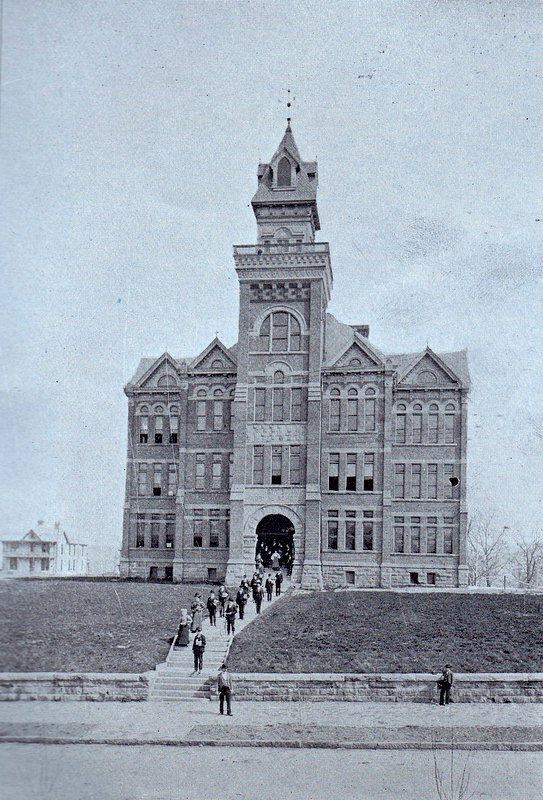
After Barnes’ departure, the Normal’s imposing structure dominated Fairmont Avenue’s South Side. However, by 1912, the school had continued growth so rapidly that the Legislature authorized the sale of the Fairmont Avenue building as well as the purchase of sufficient acreage on the southwest side of town where expansion of a larger campus was assured. In 1917, the school moved for the third time to a hillside overlooking Locust Avenue. The once imposing Normal structure was considered for various uses, vacated, sold, and then torn down during the summer of 1924. While plans to develop the property did not come to fruition, the significance of losing Barnes’ clock and bell was not overlooked in the community.
Within easy view of the Normal, but situated across the Monongahela River, East Side High School (East Fairmont High School) was in the first phase of expansion of its original building that opened in 1921. An article in the Fairmont Times on August 21, 1924, reported that Superintendent of Schools W. A. Hustead felt that the Normal clock tower had ‘certain historical connections which makes it especially desirable that it be placed in a bell tower.’ Hustead wanted the bell and clockworks for a planned ninety-two foot tall tower atop the school’s roof. He said it would be ‘visible from every section of the city’ since the high school sat upon a promontory overlooking Fairmont from the eastern side of the town.
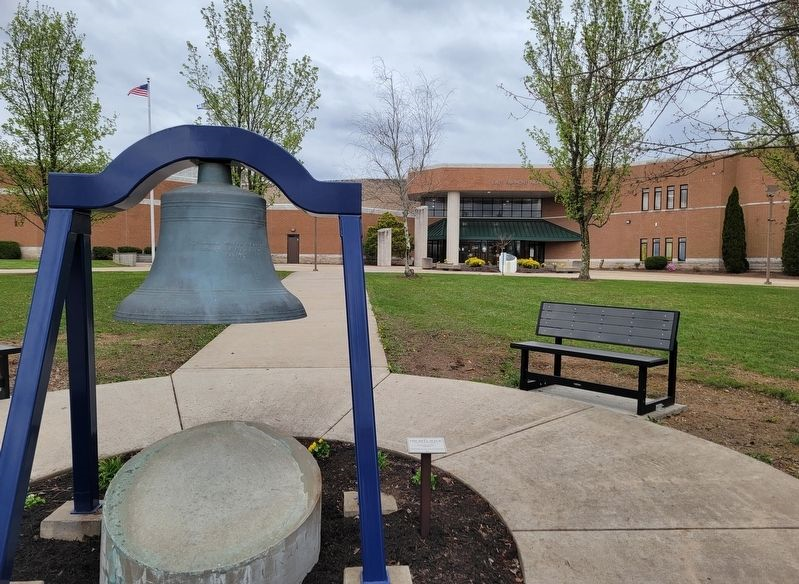
Hustead appealed to Barnes’ role as treasurer of the State Board of Control to expedite the transfer of the property to the school board. The new clock tower was completed and remained a distinct architectural feature of East Fairmont High for the next 40 years. Unfortunately, the tower was hit by lightning around 1965, and after consideration of repair expenses, the Board of Education dismantled the entire lighting-damaged bell tower structure. During the demolition, the clock components and bell were salvaged and placed in storage at the Board of Education’s Maintenance facility for safekeeping. In 1972, the EFHS Key Club members retrieved the bell and mounted it on a concrete pad outside the south entry to the building. It remained undisturbed and silent for the next 30 years. Key Club members set the bell with the engraved section facing the school and the blank side faced forward.
The high school was converted to 7th and 8th grades when a new East Fairmont High campus opened in the fall of 1993. In 2013, demolition of the old building occurred, and a new East Fairmont Middle School opened there a year later. Prior to the demolition, EFHS principal David Nuzum (one of the original Key Club members who rescued the bell in the 1970s) had it brought to the Pleasant Valley location. In 2015, EFHS student and Eagle Scout Joshua Poe spearheaded a project to erect the old Normal bell on the grounds of the high school. It now sits in a prominent, accessible location where visitors and students can read the inscription and dedication from 1899.
As for J. Walter Barnes, the school system recognized him in the late 1920s. A school erected in 1905 in Fairmont’s Bellview community to the north was officially named the J. Walter Barnes School, housing grades 1-9, when a wing designed by the noted architect William B. Ittner of St. Louis was added as part of major school expansions in Fairmont, including a new Fairmont Senior High School and Dunbar School for Black students. Ittner has been described as the most influential man in American school architecture and these school buildings were testament to quality and design at the time.
Ittner must have become aware of Barnes’ as he planned the Georgian styled addition. He incorporated his name carved into sandstone above the main entry door facing Naomi Street to identify the namesake. Also, on the proscenium arch of the new auditorium included in the expansion, Ittner added a quote from the 3rd century Greek historian Diogenes Laertius: “The foundation of every state is the education of its youth.”
By the mid 1960s, the J. Walter Barnes School’s 9th grade was transferred to Fairmont Senior High. Twenty years later, Barnes School became K-4 and middle school students were transferred to Miller School. By the end of the 1990s, Barnes School transitioned to the Barnes Learning Center, offering nontraditional education for students whose needs cannot be met in a regular, special education, or vocational school.
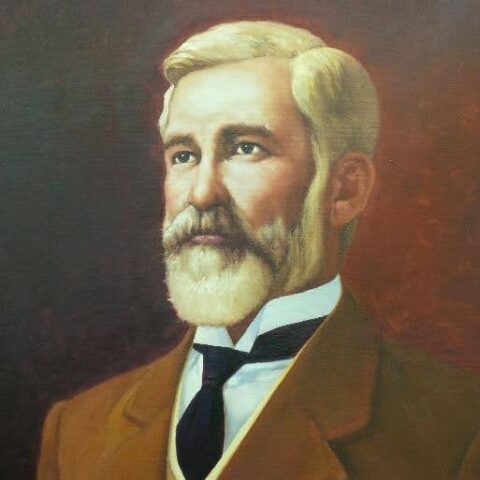
Today, J. Walter Barnes is not often prominently mentioned in local or state history. His name is often confused in academic circles with Dr. Walter Barnes, an English and Drama professor at Fairmont State College from 1914-28. Other than having his name on a former school building in Marion County, J. Walter Barnes is probably not even remembered by the legions of students who passed his photograph hanging in the main hallway outside the principal’s office at Barnes School. The sepia photo portrayed him as a much older man, white hair and a flowing grey beard. Most of the baby boomers who attended this school probably thought it was just a photo of George “Gabby” Hayes, who starred in movies as the venerable cowboy sidekick to Roy Rogers, Hop Along Cassidy, and John Wayne as well as television Westerns during the mid 1950s.
Barnes died in 1935. J. Walter Barnes and his wife Olive are among the many prominent West Virginians buried in Fairmont’s historic Woodlawn Cemetery. The cemetery includes him among the historic burials there, recognizing many significant persons whose contributions and responsive citizenry were not only integral in the development of West Virginia. Efforts at Woodlawn include promotion of cultural history and are designed to still inspire future generations to lead with the same ideals: personality, resourcefulness, sound judgment and undeniable public spirit and dedication to the Mountain State.
DR. RAYMOND ALVAREZ
Alvarez, M. Raymond. “The Undeniable Public Spirit of Fairmont’s J. Walter Barnes.” Goldenseal West Virginia Traditional Life, Fall 2025. https://goldenseal.wvculture.org/the-undeniable-public-spirit-of-fairmonts-j-walter-barnes/